

How to Spot High Quality Clothing: 7 Checks
Table of Contents
- How to Tell If Fabric Is Quality
- How to Check Garment Stitching
- How to Read Clothing Labels
- Your In-Store Clothing Quality Checklist
- Hardware and Finishing Details That Signal Quality Clothing
- How High Quality Clothing Holds Up Over Time
- Conclusion
- Frequently Asked Questions
Last Updated: October 12, 2026
How to Tell If Fabric Is Quality
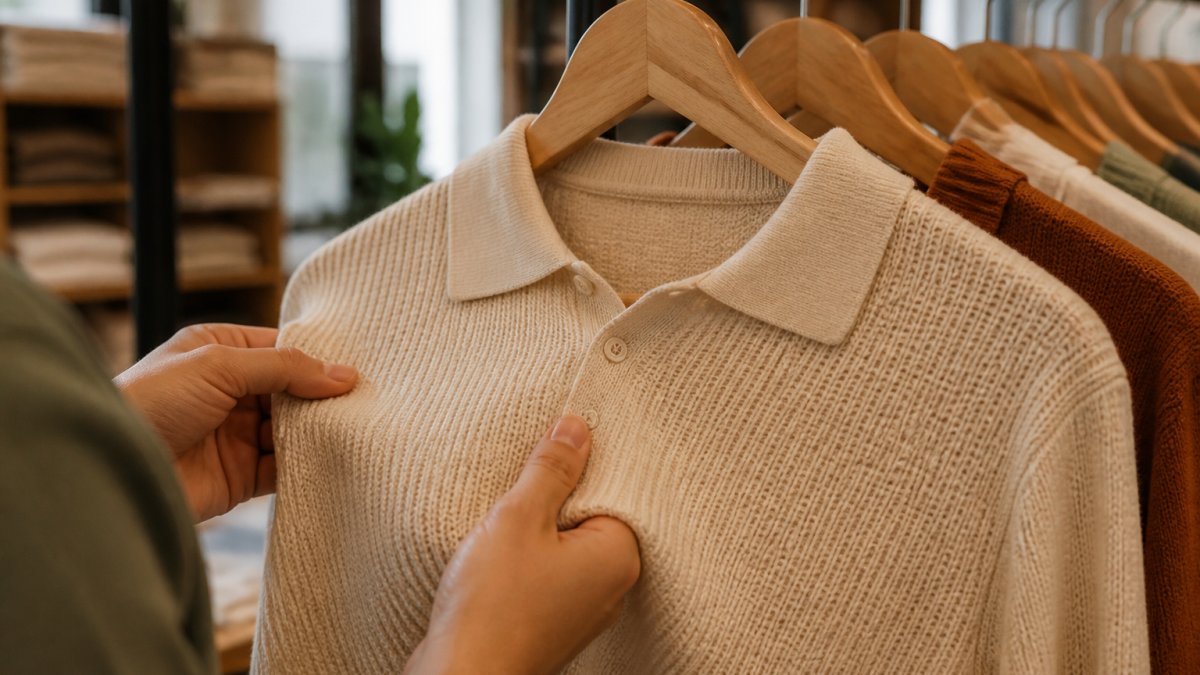
You can spot high quality clothing by doing one simple thing first: touch the fabric.
Fabric quality is how well a textile is made, judged by its fiber content, weight, density, and how it feels and drapes.
Here is the part most shoppers miss: a high price tag does not guarantee good fabric.
Natural vs. Synthetic Fibers
Natural fibers like cotton, wool, linen, and silk come from plants and animals. They breathe well, age gracefully, and feel better against the skin. Synthetic fibers like polyester, nylon, and acrylic are made from petroleum.
The catch is that most garments are blends. A cotton-polyester mix can be a smart choice for durability, but a shirt that is mostly polyester marketed as "premium cotton" is a red flag.
Fabric Weight, Density, and Drape
Fabric weight is how heavy the cloth feels in your hand. Density is how tightly the fibers are packed. Drape is how the fabric falls when you hold it up.
Hold the garment to the light. If you can see straight through it, the weave is loose and will wear out fast. A dense fabric blocks light, springs back when you crumple it, and falls in smooth folds rather than stiff, flat sheets.
How to Check Garment Stitching
Stitching is where quality clothing proves itself. Flip the garment inside out and look at the seams. Even, tight stitches signal careful construction. Crooked, loose, or wavy lines signal a rushed factory.
Run your finger along a seam. It should feel smooth and flat, not bumpy or puckered. Thin or frayed thread means the seam will come apart under stress.
Seam Straightness and Stitch Density
Straight seams follow the fabric's grain without wobbling. Stitch density is how many stitches fit per inch; more usually means a stronger seam, though too many can pucker the fabric.
The outside can look perfect while the inside tells the real story.
Reinforced Seams and Stress Points
Stress points take the most pulling: shoulders, underarms, crotch, and pocket corners. High quality clothing reinforces these with extra stitching, bar tacks, or rivets.
Check the shoulder seams and the base of any zipper for double-stitched lines and bar tacks at pocket edges. If a garment skips reinforcement here, it will fail there first.
How to Read Clothing Labels
Labels tell you what you are actually buying, and they are the one place a brand cannot easily fudge the facts. A clothing label lists fiber content, care instructions, and country of origin, read the fiber percentages first.
Fibers are listed by weight, so the first one named makes up most of the garment, but the percentages are the real story.
Decoding Fiber Blends
Blends exist for a reason, and a smart blend can outperform a pure fiber. How to read the common ones:
- Cotton + a small share of spandex (often 2-5%) adds stretch and helps a garment keep its shape. More than about 10% spandex and the fabric starts to feel rubbery and loses breathability.
- Cotton + polyester trades some softness and breathability for wrinkle resistance and durability. A 50/50 blend is a workhorse; a 90/10 blend still feels mostly like cotton.
- Wool + nylon is common in socks and suiting. The nylon adds abrasion resistance at the heels and elbows, where pure wool wears through first.
- Linen + cotton softens linen's crisp hand and reduces its tendency to crease sharply.
A red flag is a garment marketed as "premium cotton" or "luxury cashmere" whose label shows the named fiber in the minority. If the marketing word is not the first fiber listed, the label is doing the honest talking.
Care Instructions as a Durability Forecast
Care guidance is not just housekeeping, it is a hint about how the fabric will age.
Look for the standard care symbols and what they imply:
- Machine wash cold, tumble dry low, the most forgiving combination; the garment is built to survive normal laundry.
- Hand wash or dry clean only, the maker is telling you the fabric is fragile or the dye may bleed.
- Do not bleach / do not iron, often a sign of a sensitive dye or a fiber like spandex or rayon that degrades under heat.
- Wash separately, usually a warning that the dye will transfer, which also means it may fade faster over time.
A care label that reads like a list of prohibitions is fine for a special-occasion piece, but a poor fit for something you plan to wear twice a week.
Federal Trade Commission guidance on textile and wool labeling requires accurate fiber content and care information on garment labels, so you can trust what you read there, but you still have to interpret it.
Country of Origin and What It Does (and Does Not) Tell You
The label also lists where the garment was made. Country of origin is a useful signal about the supply chain, but it is not a quality grade, well-made and poorly made garments come from the same countries.
Galardo Men's Knitted Button-Up Shirt →
The label is the garment's spec sheet. Read the percentages, decode the care symbols, treat the origin line as context, then let the fabric and seams confirm what the label promises.
Your In-Store Clothing Quality Checklist
Use this checklist every time you shop. It turns a vague sense of "this feels nice" into a repeatable test.
- Touch the fabric and check for a dense, substantial feel
- Hold it to the light to check weave density
- Crumple it and see if it springs back
- Flip it inside out and inspect the seams
- Check stitch density and evenness
| Check | What to Look For | Red Flag |
|---|---|---|
| Fabric feel | Dense, springy, smooth | Thin, stiff, scratchy |
| Weave density | Blocks light | See-through |
| Seams | Straight, even | Crooked, puckered |
| Stitching | Tight, consistent | Loose, frayed |
| Stress points | Reinforced, bar tacks | Single stitch only |
| Hardware | Smooth zipper, clean holes | Sticky, frayed edges |
Hardware and Finishing Details That Signal Quality Clothing
Hardware and finishing separate well-made garments from the rest.
Test the zipper by running it up and down. It should glide without catching. Check the zipper tape for tight stitching.
Buttons should feel solid, not flimsy, and buttonholes should be cleanly cut with tight stitching around the edges.
Lining and finishing matter too. A smooth lining slides on easily and protects the outer fabric.
ASTM International standards for textile testing covers how fabrics are tested for strength and colorfastness, which is the same durability workmanship aims for.
How High Quality Clothing Holds Up Over Time
Durability is the real test, and it is where the checks you did in the store pay off. Quality clothing resists pilling, shrinkage, and fading, keeping its shape and fit after many washes, while cheap garments stretch at the collar and lose color fast.
What Actually Causes Pilling, Shrinkage, and Fading
Pilling happens when short fibers work loose from the yarn, tangle together, and form little balls on the surface.
Shrinkage comes from fiber relaxation and mechanical agitation. Cotton and wool fibers were stretched during spinning and weaving; heat and water let them relax back toward their natural length.
Fading is about dye penetration and fiber type. Dyes that bond deeply into the fiber resist washing out; surface-dyed or poorly fixed dyes bleed and fade.
The Cost-Per-Wear Calculation
Price alone tells you nothing about value. The useful number is cost per wear: divide the price by the number of times you realistically wear the garment.
A $30 shirt you wear 100 times costs $0.30 per wear.
The math flips the usual instinct: the cheapest garment on the rack is often the most expensive to own. Ask not "what does it cost today" but "how many good wears will I get, and at what cost each."
How Quality Varies by Garment Category
Construction standards differ by category, so the checks that matter most change with the garment:
- Denim, Look for chain-stitched hems (a continuous loop that allows the fabric to rove and fade naturally), reinforced bar tacks at pocket corners and belt loops, and selvedge or tightly woven denim that holds its shape. Cheap denim uses single-stitch hems that pucker and pop.
- Knitwear, Check the gauge (stitches per inch) and the fiber length. Fine-gauge merino outlasts coarse acrylic. Look for fully fashioned shoulders, where the sleeve is knitted to shape rather than cut and sewn, which reduces bulk and stretching at the seam.
- Shirts, Examine the collar and cuffs for fused versus sewn interlining. Fused interlining (glued) can bubble after washing; sewn interlining holds its shape for years. Check for a split yoke, which allows the shirt to fit across the shoulders better.
- Coats, Look at the lining attachment, the weight of the outer fabric, and whether the seams are bound or raw. A coat with a hanging lining (attached only at the top and bottom) drapes better and is easier to alter.
- Activewear, Check for flatlock seams, which lie flat against the skin and reduce chafing, and for four-way stretch fabric that recovers its shape. Cheap activewear uses standard seams that rub and loses stretch after a few washes.
Care That Extends Lifespan
Care extends lifespan more than any single purchase decision. Wash cold, turn garments inside out, and air dry when you can. Store knitwear folded, not hung, use mesh bags for delicates, and avoid overloading the machine.
Think about cost per wear, not just price. A shirt you wear often for years costs less per wear than a cheap one that falls apart in months. That is the quiet value of quality clothing, measurable, not just a feeling.
Conclusion
Spotting high quality clothing comes down to a few habits: feel the fabric, inspect the seams, read the label, and check the hardware. Do these checks and you will stop wasting money on garments that fail early. At Vinthentic, we build our collection around genuine leather craftsmanship, handcrafted precision, and timeless design made for everyday comfort. Our customers, like Stephen H., tell us the quality is top-notch, and more than 20,000 happy customers agree.
Frequently Asked Questions
How can you tell if fabric is high quality?
Feel the fabric between your fingers and check the label for fiber content. Natural fibers like cotton, wool, and silk tend to breathe better and last longer than synthetic blends. Look for a tight weave or knit with no visible gaps. Hold the fabric up to light to check density, and gently stretch it to see if it springs back into shape. High quality clothing uses fabrics that feel substantial without being stiff.
What should you check in a garment's seams and stitching?
Turn the garment inside out and inspect the seams. Stitches should be tight, even, and consistent with no loose threads or skipped stitches. Seams should run straight without puckering. Check stress points like shoulders, armholes, and pockets for reinforced stitching or bar tacks. A well-made garment uses a consistent stitch density throughout, and the seam allowance should be finished to prevent fraying.
Does a higher price mean clothing is better quality?
Price alone does not guarantee quality. Some expensive brands rely on marketing rather than craftsmanship. Instead of trusting the price tag, inspect the fabric, stitching, and finishing details yourself. A $40 shirt with tight seams and quality cotton can outperform a $150 shirt with loose threads and thin fabric. Use cost-per-wear as your measure: a durable piece worn often delivers more value than a cheap item that falls apart.
How can you tell whether clothing will hold its shape?
Check the fabric's recovery by gently stretching it and seeing if it snaps back. Look for shape retention features like darts, lined shoulders, and reinforced collars. Read the care label to see if the garment requires special handling that might affect its lifespan. High quality clothing made from dense natural fibers with proper construction holds its shape through repeated washing and wearing far better than loosely knit or thinly woven alternatives.
Read more

Why Premium Leather Goods Cost More
Premium leather goods cost more due to material quality, craftsmanship, and durability. Learn what drives pricing and whether the investment pays off.
Read more
Men's Leather Shoes for Formal Settings: 2026 Guide
Formal leather shoes: Find the best men's leather shoes for formal settings.
Read more