
Durable Timeless Apparel for Professionals: A 2026 Guide
Table of Contents
- Why Durable Timeless Apparel for Professionals Beats Fast Fashion
- The 6 Wardrobe Staples Every Professional Needs
- How to Build a Capsule Wardrobe That Actually Lasts
-
Evaluating Sustainable Business Casual Brands by Cost-Per-Wear
- The Basic Formula and Its Limitations
- Factor 1: The Time Value of Money and Opportunity Cost
- Factor 2: The Cost of Appearance and Professional Image
- Factor 3: The Repair and Maintenance Multiplier
- A Practical Decision Framework
- The Psychological Barrier: Why We Still Buy Cheap
- A More Complete Comparison Table
- Fabric Longevity: Choosing Textile Quality Over Trends
- Care and Maintenance: Extending the Life of Your Investment Pieces
- Fit Optimization and Transitioning from Remote to Office
- Conclusion: Build a Professional Wardrobe That Works for Years
- Frequently Asked Questions
Last Updated: September 5, 2026
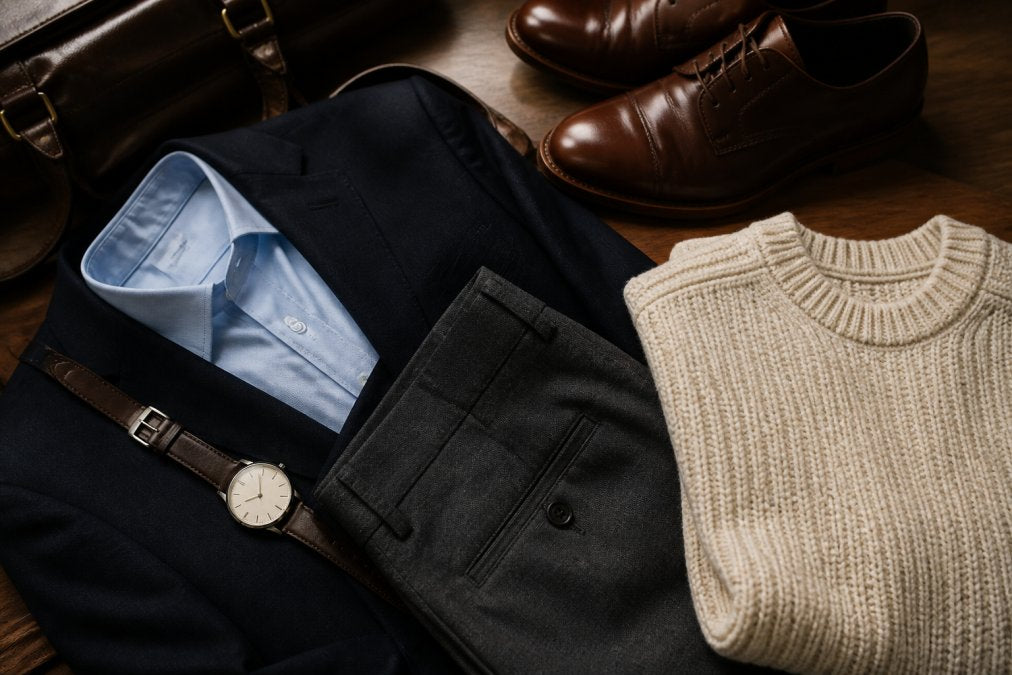
Fast fashion promises a bargain, but the true cost of a garment is measured in replacements, repairs, and the slow erosion of your professional image. For men aged 30-50 in corporate environments, the smarter calculation favors durable timeless apparel for professionals, where quality construction and classic design outlast seasonal trends.
The core principle is simple: buy fewer, better things. A capsule collection built on natural fibers and genuine craftsmanship serves you for years, not months, and projects a stability that cheap, trend-driven pieces never can.
Why Durable Timeless Apparel for Professionals Beats Fast Fashion
The most expensive clothing you own is the item you replace most often. Fast fashion operates on planned obsolescence, using low-grade synthetics and loose stitching that surrenders to the wash cycle within a season (the EPA). Durable timeless apparel for professionals inverts that logic, prioritizing fabric longevity and construction so each piece delivers years of service.
Sustainable fashion is not just an environmental stance; it is a financial strategy. When you shift toward investment pieces, you stop paying the "fast fashion tax" of repeated small purchases that never quite look right. A worn collar or pilled fabric undermines your professional image instantly.
The 6 Wardrobe Staples Every Professional Needs
A versatile office wardrobe does not require a massive closet. It requires six core items that mix and match into dozens of outfits and transition seamlessly from business casual to smart casual settings.

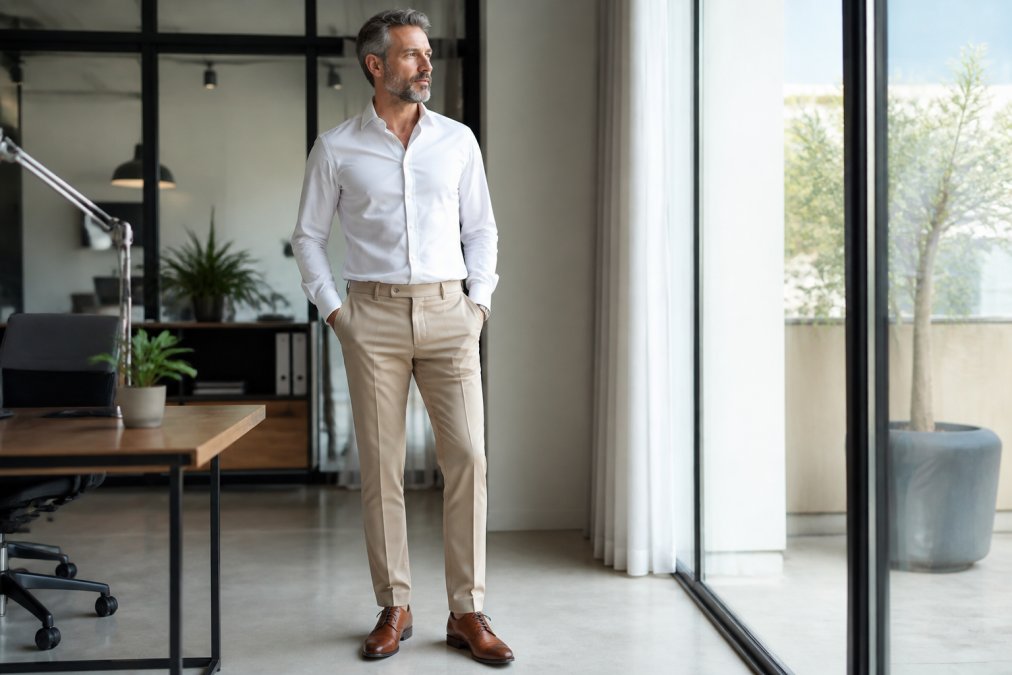
- Tailored trousers in a neutral tone (navy, grey, or khaki)
- Button-up shirts in natural fibers (cotton or linen)
- Oxford shoes in genuine leather
- A versatile blazer in a classic silhouette
- A quality knit polo for less formal days
- A leather belt that matches your footwear
The Foundation: Tailored Trousers and Oxford Shoes
Trousers and shoes anchor your entire silhouette. A tailored trouser creates clean lines that read as polished. The Oxford shoe is the definitive professional choice, and its timeless design ensures it remains appropriate for years.
Genuine leather molds to your foot over time, providing comfort synthetics cannot replicate, and develops a patina that adds character without looking worn out. The Vinthentic Timeless Men's Oxford Shoes offer a cushioned insole and durable construction at $47.99, making them a practical entry point into quality footwear.

The Workhorse: Button-Up Shirts in Natural Fibers
Your shirt does the heaviest lifting in a professional wardrobe. Natural fibers like organic cotton and merino wool offer breathability that polyester blends lack, keeping you composed through long meetings. Its construction determines how it holds up after dozens of wears and washes.
Look for a shirt with a tailored fit that follows your body without pulling. The Vinthentic Men's Business Casual Button-up Shirt at $39.99 is crafted from premium fabrics designed for comfort and durability. Pair it with a blazer for formal meetings or wear it alone for a clean, minimalist aesthetic.
How to Build a Capsule Wardrobe That Actually Lasts
Building a capsule wardrobe is a deliberate process, not a shopping spree. The goal is a collection where every piece coordinates with several others, maximizing outfit combinations while minimizing total items. Start by auditing your closet and identifying gaps in your essentials.
Focus on classic silhouettes and a cohesive palette of navy, grey, white, and earth tones. When you add a piece, ask if it works with at least three existing items. If not, skip it. This prevents orphan garments that only work in one outfit.
Evaluating Sustainable Business Casual Brands by Cost-Per-Wear
The sticker price is only half the story. Cost-per-wear (CPW) reveals true value, but most guides stop at the simple formula: price divided by wears. A rational decision requires a more complete model accounting for real-world variables.
The Basic Formula and Its Limitations
The basic formula is: CPW = (Purchase Price + Maintenance Cost) / Number of Wears
A $100 shirt worn 50 times costs $2 per wear. A $30 shirt worn five times costs $6 per wear. This math is compelling, but it misses three critical factors that distort the real cost.
Factor 1: The Time Value of Money and Opportunity Cost
A $200 pair of leather oxfords requires $200 today, while a $60 pair of synthetics requires only $60. That $140 difference could be invested. Over 5 years at a conservative 5% annual return, it grows to roughly $179, narrowing the gap between cheap and quality items (investor.gov).
However, this ignores replacement cost. If the $60 shoes last one year, you will buy five pairs over five years, spending $300 total. The $200 leather pair may last a decade. The math still favors quality, but the decision is not as lopsided as the simple formula suggests.
Factor 2: The Cost of Appearance and Professional Image
There is a hidden cost to wearing garments that look worn. A pilled collar or scuffed synthetic shoe signals inattention. In client-facing roles, a polished appearance can contribute to perceived competence.
Factor 3: The Repair and Maintenance Multiplier
Quality garments are repairable; cheap ones are not. A $200 leather shoe can be resoled for $60-$80, extending its life by 3-5 years (extension.iastate.edu). A $60 synthetic shoe cannot be resoled; when the sole wears through, the entire shoe is trash. This "maintenance multiplier" dramatically lowers long-term CPW.
A Practical Decision Framework
To move beyond simple arithmetic, use this three-step framework when evaluating a sustainable brand:
- Estimate the Realistic Lifespan: Be honest about your rotation. If you wear a shirt once a week, a quality shirt might last 3-5 years (150-250 wears). If you wear it daily, it will wear out faster. Divide your estimated total wears into the price.
- Add the Repair Budget: For shoes and outerwear, add a realistic repair cost (e.g., $80 for a resole) and divide that into the extended lifespan it buys.
- Apply the 3-Outfit Rule: A versatile staple that pairs with three different outfits effectively triples its utility. A $100 shirt that works in three contexts is more valuable than a $100 shirt that only works in one, even if the raw CPW is identical.
The Psychological Barrier: Why We Still Buy Cheap
The rational math favors quality, yet most professionals still buy fast fashion. The reason is loss aversion: the pain of spending $200 today is more acute than the pleasure of saving $300 over five years. We prefer immediate, certain savings over delayed, probabilistic ones.
The counter-strategy is to reframe the purchase as a commitment. Instead of asking "Can I afford this $200 shoe?" ask "Am I willing to commit to wearing it 200 times?" If yes, the CPW drops to $1 per wear, objectively cheaper than any fast-fashion alternative.
A More Complete Comparison Table
| Wardrobe Item | Initial Price | Repair Cost (Est.) | Expected Lifespan | Total Wears (Est.) | True Cost-Per-Wear |
|---|---|---|---|---|---|
| Fast Fashion Shirt | $30 | $0 (not repairable) | 5-10 washes | 10 | $3.00 |
| Quality Oxford Shirt | $100 | $0 | 50+ washes | 100 | $1.00 |
| Synthetic Oxford Shoes | $60 | $0 (not repairable) | 1-2 years | 100 | $0.60 |
| Genuine Leather Oxfords | $200 | $80 (resole at year 5) | 10+ years | 500 | $0.56 |
This table reveals the counterintuitive truth: a $200 pair of leather shoes, when properly maintained, can achieve a lower cost-per-wear than a $60 pair of synthetics. The initial price is a barrier, but the long-term economics are clear. The question is not whether you can afford the investment, but whether you can afford the repeated replacements.
Fabric Longevity: Choosing Textile Quality Over Trends
Textile quality is the invisible difference between a garment that lasts and one that disintegrates. While most guides stop at "buy natural fibers," the real differentiator is understanding the specific mechanisms of fabric longevity, allowing you to evaluate construction before you buy.
Fiber, Weave, and Finish: The Three Pillars of Durability
Fabric longevity is determined by three interacting factors: the fiber, the weave, and the finish. Each plays a distinct role in how a garment withstands stress, washing, and time.
Fiber: Long-staple cotton, such as Egyptian or Supima, spins into a smoother, stronger yarn less prone to pilling than the short-staple cotton used in most fast fashion. For wool, Super 110s to 120s offers the best balance of softness and durability for daily wear. Merino wool resists wrinkles and odors far better than synthetics.
Weave: A poplin weave is crisp and durable, ideal for dress shirts. A twill weave is softer and drapes better, common for chinos. For suiting, a plain weave is lightweight and breathable, while a hopsack weave is more textured and resilient. A high thread count (200+ for shirts) indicates density, but can reduce breathability if too high.
Finish: A "mercerized" garment has been treated to increase luster, strength, and dye affinity, making it less likely to fade. Be wary of "wrinkle-free" finishes, which often use formaldehyde-based resins that weaken fibers over time. A truly durable garment relies on fiber and weave quality, not chemical crutches.
The Mechanism of Wear: Why Garments Fail
Understanding why garments fail helps you identify weak points before purchase. Common failure points include abrasion (thinning at elbows and knees), pilling (common in short-staple cottons and synthetics), seam slippage (check for 8-12 stitches per inch), and color fading (fiber-reactive dyes are more colorfast).
A Practical In-Store Evaluation Checklist
Before you commit to a purchase, run this quick physical inspection:
- The Stretch Test: Gently pull the fabric along both the warp (lengthwise) and weft (crosswise) threads. A quality fabric will resist stretching and return to shape. A fabric that stretches easily and stays stretched indicates poor fiber integrity.
- The Light Test: Hold the fabric up to a light source. If you can see light through a densely woven shirt, it is likely too thin for long-term professional wear.
- The Seam Check: Turn the garment inside out. Examine the seams. Are the edges finished with a serger (overlock) stitch to prevent fraying? Is the stitching straight and tight? Look for a "felled" seam (common on premium shirts) where the raw edge is folded and stitched flat for maximum strength.
- The Button Test: Tug on a button. Is it secured with a shank (a small thread stem) that provides space for the button to sit? Are there reinforcing stitches? A loose button is a sign of rushed assembly.
This level of technical scrutiny is the difference between buying a "durable" item that lasts three years and one that lasts ten. It is the same diligence a professional applies to any other significant investment.
Care and Maintenance: Extending the Life of Your Investment Pieces
Proper care is the cheapest upgrade you can give your wardrobe. Most professionals ruin their investment pieces in the laundry room, not on the job. Read the care label and wash less frequently; over-washing is the primary killer of fabric longevity.
For leather shoes, invest in a cedar shoe tree and rotate your pairs to let the leather dry and maintain its shape. The Sandro Botticelli Genuine Leather Oxford Shoes at $54.99 and the Luca Giordano Leather Oxford Shoes at $64.99 reward this attention with years of service.

For shirts, hang them immediately after drying on a good quality hanger to minimize wrinkles and prevent shoulder deformation. Spot-clean stains immediately. A small investment in quality detergent and leather conditioner pays dividends in garment lifespan.
Fit Optimization and Transitioning from Remote to Office
The return to the office demands a clear-eyed reassessment of your wardrobe. The most common error is wearing remote-work loungewear that is too casual or pre-pandemic suits that no longer fit. Fit optimization is the single highest-impact change you can make.
A tailored fit means the shoulder seam aligns with your shoulder bone, the jacket waist nips in slightly, and the trouser breaks cleanly at the shoe. If your weight has changed, have your suits tailored; alterations are inexpensive compared to replacement costs.
Transitioning from remote to office requires versatile pieces that bridge comfort and professionalism. A quality polo like the Vinthentic Federico Men's Polo shirt at $44.99 offers a polished look without the formality of a full suit. Pair it with tailored trousers and leather oxfords for a smart casual ensemble.
Conclusion: Build a Professional Wardrobe That Works for Years
Building a professional wardrobe is about curating durable, versatile pieces that reflect your competence, not chasing trends. At Vinthentic, we focus on genuine leather craftsmanship and premium materials designed for everyday comfort and timeless style. Explore our collection of oxford shoes and button-up shirts to find staples that elevate your professional presence.
Frequently Asked Questions
What is the 3-3-3 rule for clothing?
The 3-3-3 rule is a simple styling method to simplify outfit choices. You pick three tops, three bottoms, and three pairs of shoes to create nine distinct outfits for the week. This approach encourages professionals to focus on versatile, durable timeless apparel that mixes well, rather than owning many pieces that don't coordinate. It is a practical starting point for building a capsule wardrobe.
How do you identify high-quality, durable fabrics for workwear?
Look for tightly woven natural fibers like organic cotton, merino wool, and linen. High-quality materials feel substantial and have a clean finish on the seams. Check the garment construction, including the stitching and buttons, as these details indicate fabric longevity. A high thread count in cotton shirts or a full-grain leather shoe upper are strong signs of textile quality that will withstand regular wear.
How can sustainable business casual brands improve my professional image?
Sustainable business casual brands often focus on classic silhouettes and durable construction, which projects a more polished and thoughtful image than disposable fast fashion. Wearing high-quality materials that fit well signals attention to detail and self-respect. This approach to professional attire shows you value long-term investment over short-term trends, a trait often associated with strong leadership and reliability.
Why is investing in sustainable, durable apparel better for your career image?
Investing in durable timeless apparel for professionals ensures you always look put-together. High-quality pieces maintain their shape and color, avoiding the faded or worn look that undermines authority. This consistency builds a personal brand of reliability. Over time, the cost-per-wear of a quality pair of oxford shoes can be lower than replacing cheap footwear every few months, making it a smarter financial and professional choice.
Read more
Modern Ways to Wear Vintage Clothing: 2026 Guide
Discover modern ways to wear vintage clothing without looking costumey. Learn styling tricks, capsule wardrobe tips, and tailoring advice for 2026.
Read more
Fast Shipping Premium Clothing Stores: 2026 Guide
Compare fast shipping premium clothing stores with real delivery speeds, costs, and policies. Find out which retailers get premium apparel to your door.
Read more