
Why Traditional Tailoring Lasts Longer: A 2026 Guide
Table of Contents
- The Anatomy of a Suit: What's Actually Inside Your Jacket
- Benefits of Full Canvas Suit Construction for Longevity
- Natural vs Synthetic Fabric Longevity: Why Fiber Choice Decides Lifespan
- How to Care for Tailored Wool Garments (Without Shortening Their Life)
- Repairability and Mending: The Hidden Advantage of Traditional Tailoring
- Cost-Per-Wear: The Real Math Behind Traditional Tailoring
- Conclusion: Why Traditional Tailoring Still Wins on Longevity
- Frequently Asked Questions
Last Updated: October 3, 2026
The Anatomy of a Suit: What's Actually Inside Your Jacket
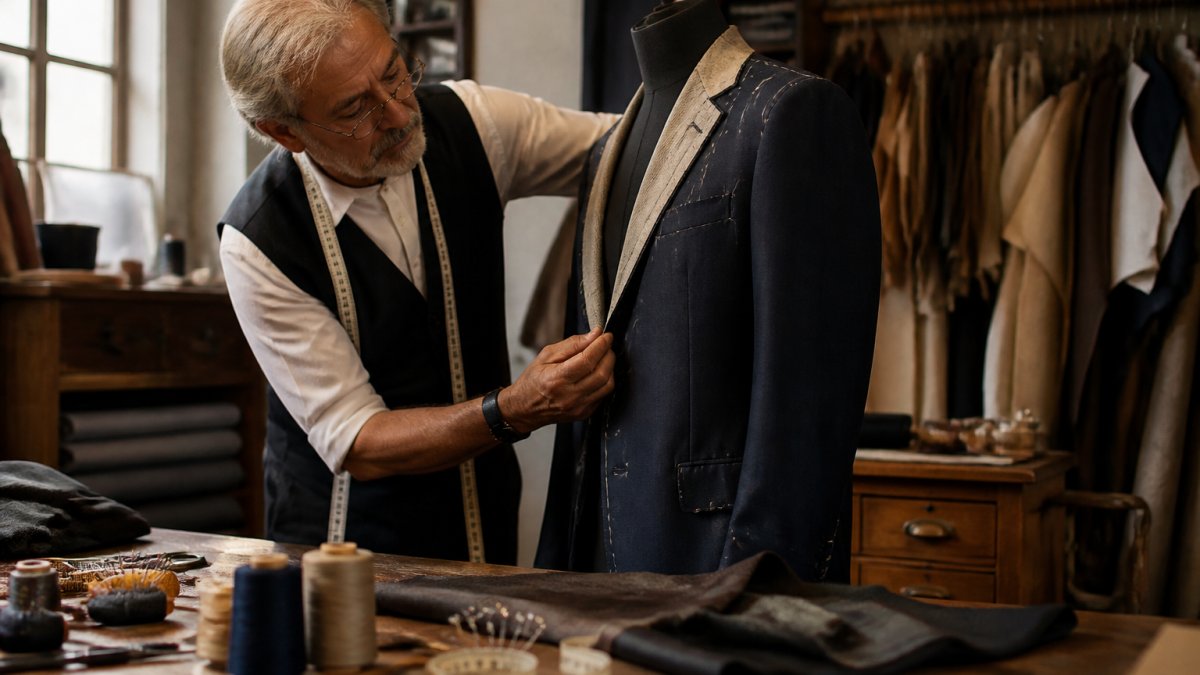
Most people judge a jacket by its outer fabric. The real answer to why traditional tailoring lasts longer sits underneath it. A tailored jacket is a layered structure, and the chest piece is what holds its shape over years of wear. At Vinthentic, we build our collections around that principle: what you cannot see determines how long a garment survives.
Three internal systems decide a jacket's lifespan:
- The canvas gives the chest its curve and roll
- The stitching holds every layer in position
- The lining protects the structure from friction
Cheap jackets skip the first entirely. That is where the trouble starts.
Canvas, Fusing, and the Chest Piece
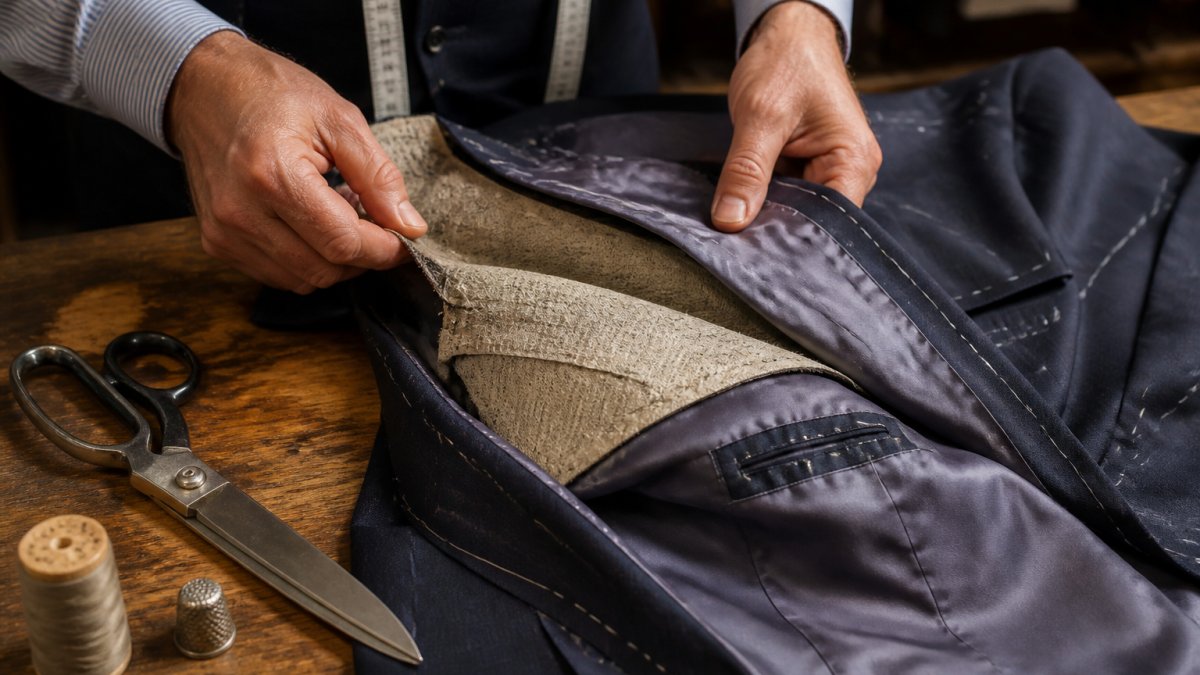
Canvas application is the traditional method of attaching a woven wool or horsehair layer inside the chest, secured with rows of stitching rather than glue. The canvas moves with the body and recovers its shape after wear.
Fused construction replaces that layer with an adhesive interfacing bonded to the outer fabric under heat. It is faster and cheaper to produce. It also bubbles, delaminates, and stiffens with repeated dry cleaning.
Stitching, Seams, and Why They Fail
Hand-stitching allows a seam to flex without breaking. Machine stitching, especially short, dense stitch lengths on fused cloth, concentrates stress at each needle point. Over time, that is where seams split.
A common mistake is assuming a high thread count means quality. In practice, the stitch method matters far more than the count.
Benefits of Full Canvas Suit Construction for Longevity
The main benefit of full canvas suit construction is shape retention across years, not months. A full-canvas jacket has canvas running through the entire front panel, so the chest, lapel roll, and shoulder line hold their form through repeated wear and cleaning.
Here is what changes as a jacket ages:
| Construction | Shape After 3-5 Years | Repair Options | Dry Cleaning Tolerance |
|---|---|---|---|
| Full canvas | Holds chest and lapel roll | Can be re-stitched | High |
| Half canvas | Chest holds, lower front softens | Limited re-stitching | Moderate |
| Fused | Bubbling, edge curl | Rarely repairable | Low |
The difference is not visible on day one. It shows up in year three.
Half-Canvas and Fused: What Changes Over Time
Half-canvas construction uses canvas in the chest and shoulder but fuses the lower front. It is a reasonable middle ground and holds up better than fully fused garments. The lower panel still softens faster than the chest.
Fused jackets fail predictably. Heat, moisture, and dry cleaning solvent break down the adhesive. Once the bond releases, the fabric separates from the interfacing and no tailor can reverse it.
Natural vs Synthetic Fabric Longevity: Why Fiber Choice Decides Lifespan
Natural fibers outlast synthetics in tailored garments because they recover from stress instead of stretching permanently. Wool, in particular, has a natural crimp that lets fibers return to position after being compressed or hung.
Here is how the two compare in practice:
- Wool: resists wrinkling, breathes, releases odors, and can be rewoven
- Polyester blends: resist abrasion but hold oils and odors, and pill at friction points
- Cotton: strong but creases sharply and has limited shape memory
- Viscose and rayon: drape well but weaken when wet and lose structure quickly
Fabric weight also matters. A mid-weight wool holds a crease and a silhouette longer than a lightweight cloth, which distorts at the elbows and seat. Breathability is not just comfort; it reduces the moisture that breaks down fibers from the inside. Textile integrity is what makes a garment worth repairing.
How to Care for Tailored Wool Garments (Without Shortening Their Life)
Most premature garment death comes from cleaning, not wearing. Proper care for tailored wool garments is mostly about doing less, more deliberately.
Brushing, Resting, and Rotating
Brush wool with a soft bristle brush after each wear to lift dust before it works into the fiber. Hang the garment on a shaped wooden hanger for at least 24 hours before wearing it again. Rotation across three or more jackets spreads the wear and lets each one recover.
Cleaning, Pressing, and Storage
Dry clean sparingly. Solvent strips natural oils from wool and stresses fused interiors. Spot-clean when possible and air garments out between wears. Press with steam rather than direct heat. Store in a breathable cotton bag, never plastic, and keep cedar or lavender nearby for pest control.
| Task | Frequency | Why It Matters |
|---|---|---|
| Brushing | After each wear | Removes grit before it abrades fibers |
| Resting | 24-48 hours between wears | Lets fibers recover their shape |
| Dry cleaning | Once or twice a year | Solvent degrades fibers and adhesives |
| Steaming | As needed | Removes creases without heat damage |
Repairability and Mending: The Hidden Advantage of Traditional Tailoring
Repairability is the factor almost no buying guide mentions, and it is the single clearest reason a traditionally constructed garment outlives a fused one.
Think of a canvas jacket as a system of serviceable parts. Each part has a known failure mode and a known fix:
- Lining, the first thing to wear through, usually at the underarm and the back yoke where friction is highest. A tailor opens the seam at the hem, removes the old lining, and sets a new one using the original pattern piece. On a canvas jacket this is a routine job; on a fused jacket the same opening often disturbs the bonded front panel.
- Buttons and buttonholes, shank buttons are attached with thread that can be re-wrapped, and hand-worked buttonholes can be re-stitched. A fused jacket's machined buttonholes are usually fine, but the surrounding cloth is often too stiff to re-press cleanly after the repair.
- Seams, a split shoulder seam or a blown outseam can be re-stitched along the original stitch line. Because canvas is stitched rather than glued, the tailor can follow the existing needle holes instead of punching new ones.
- Canvas itself, the chest piece can be re-tacked to the outer cloth if it shifts, and in some cases a tailor can add a supplemental layer of canvas to reinforce a collapsing chest.
- Pockets and facings, worn pocket bags and frayed facings can be replaced independently, which is why a well-made jacket can look tired in one area and be brought back without touching the rest.
This is where alterations become an investment rather than a cost. Letting out a seam, shortening a sleeve, or taking in the waist extends a canvas jacket by years.
Men's Leather Oxford Dress Shoes →
A common pattern among tailors who handle both types is a simple triage: if the jacket is canvased, they quote the repair; if it is fused and the bubbling has started, they decline, because there is no reversible fix.
Design obsolescence is the other half of the equation. A classic silhouette does not date the way a trend-driven cut does, which means the garment stays in rotation long enough for repairs to make financial sense. A jacket you still want to wear in year seven is a jacket worth re-lining in year five.
The repairability advantage compounds. Every repair you can perform is a year you do not have to replace the garment, and every year you do not replace it is a year the original purchase price spreads across more wearings. That is the bridge to the cost-per-wear math.
Cost-Per-Wear: The Real Math Behind Traditional Tailoring
Cost-per-wear is the price of a garment divided by the number of times you wear it.
The formula is simple:
Cost per wear = Purchase price ÷ Total wearings
What makes the formula useful is that the two numbers move in opposite directions. A higher purchase price raises the numerator, but a longer service life raises the denominator faster.
Here is the comparison most buying guides skip. Assume a jacket worn twice a week for a 40-week wearing season, roughly 80 wearings a year.
| Scenario | Upfront Price | Wearings per Year | Years in Service | Total Wearings | Cost per Wear |
|---|---|---|---|---|---|
| Fused jacket, replaced when it bubbles | Lower | 80 | ~2 | ~160 | Higher |
| Half-canvas jacket | Mid | 80 | ~5 | ~400 | Lower |
| Full-canvas jacket, maintained | Higher | 80 | ~10 | ~800 | Lowest |
Now add the repair variable, which is where the math separates traditional tailoring from everything else.
This is the core argument for investment-grade clothing. Fast fashion wins on the price tag and loses on every other measure. The same logic applies to footwear: our Men's Leather Oxford Dress Shoes are built for repeated wear with a leather upper and a comfortable sole, which is what keeps them in rotation long enough for the math to work.

Two caveats keep the math honest. First, cost-per-wear only works if you actually wear the garment, a jacket that hangs unworn has an infinite cost per wear regardless of construction.
Craftsmanship, patterning, and hand-stitching are not nostalgia.
Conclusion: Why Traditional Tailoring Still Wins on Longevity
Longevity in tailored clothing comes down to construction, fiber, and care, in that order. Canvas holds shape where fusing fails. Wool recovers where synthetics stretch. Repair keeps a good garment in service where a cheap one goes to landfill.
Vinthentic builds for that longer timeline. Our pieces lean on genuine leather craftsmanship, handcrafted precision, and timeless design that does not date out of your wardrobe. Our customers notice the difference: as David S. put it, "The shoes arrived quickly and were exactly as imagined. Perfect for daily wear."
If you want garments that earn their cost per wear, browse the collection and choose pieces built to stay.
Frequently Asked Questions
What construction techniques distinguish traditional tailoring from mass-produced clothing?
Traditional tailoring uses a canvas chest piece that is sewn, not glued, to the jacket's outer fabric. This lets the garment move with your body and hold its shape over time. Mass-produced jackets use fused construction, where a synthetic interlining is heat-bonded to the fabric. That bond can bubble, peel, or stiffen after repeated cleaning. Hand-stitching, natural fibers, and generous seam allowances also separate traditional tailoring from factory-built alternatives, and each one affects how many years the garment stays wearable.
How does hand-stitching affect the durability and flexibility of a suit?
Hand-stitching creates small, flexible connections between layers instead of a rigid, continuous bond. That flexibility lets the jacket move with your shoulders and chest without stressing the fabric. It also makes repairs easier, because a tailor can open a seam, replace a worn panel, or adjust the fit without destroying the surrounding structure. Machine-fused seams often fail as a single unit, which is why a fused jacket tends to look worn out long before a hand-stitched one does.
Does 100% natural fiber content contribute to the longevity of tailored garments?
Natural fibers like wool, linen, and cotton age differently than synthetics. Wool resists odor, breathes, and recovers its shape after wearing, which reduces the need for frequent dry cleaning. Polyester and nylon blends can be durable in tensile terms, but they trap odor, pill, and hold creases permanently. For tailored garments, a high natural fiber content usually means the fabric responds well to pressing, alteration, and repair. That combination extends the garment's useful life far beyond what a synthetic blend typically delivers.
How can you identify high-quality tailoring versus glued alternatives?
Pinch the front of the jacket between the outer fabric and the lining, about halfway down the chest. If you feel a separate floating layer, that is canvas. If the layers feel glued together, that is fusing. Check the buttonholes: hand-finished ones have slight irregularity. Look at the shoulder seam and the lining attachment for visible hand stitches. Finally, ask about seam allowances. Traditional tailoring leaves extra fabric for future alterations, while fused garments often have almost none.
Read more
6 Best Sustainable Men's Footwear Brands 2026
Discover the 6 best sustainable men's footwear brands for 2026. Compare vegan leather, barefoot styles, prices, and eco-friendly materials. Find your pair.
Read more
Is Ergonomic Footwear Worth the Investment?
Is ergonomic footwear worth the investment? Compare costs, benefits, and real value per wear to decide if ergonomic footwear earns a place in your closet.
Read more