
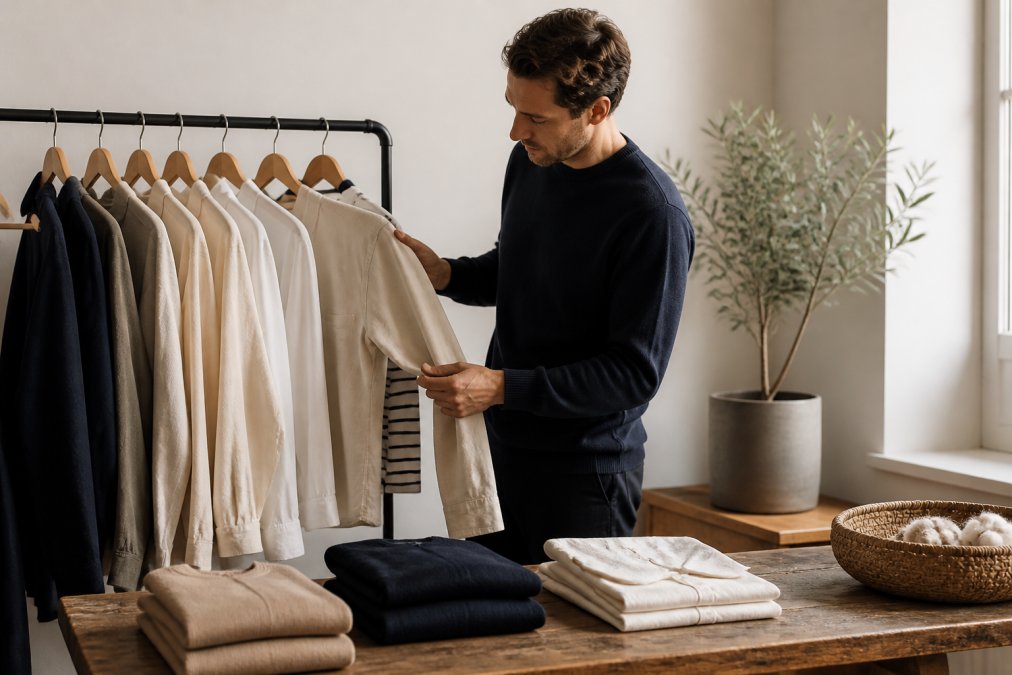
How to Start an Ethical Men's Wardrobe: 2026 Guide
Table of Contents
- Start With a Wardrobe Audit, Not a Shopping Spree
- How to Build a Capsule Wardrobe That Fits Real Life
- Your Men's Wardrobe Essentials List: The 12-Piece Core
- How to Spot Sustainable Men's Clothing Brands Before You Buy
- Fabric Deep-Dive: Organic Cotton, Tencel, and Recycled Polyester
- Repair, Mending, and End-of-Life Clothing Management
- Capsule Wardrobes for Specific Climates and Lifestyles
- Frequently Asked Questions
Last Updated: September 21, 2026
Start With a Wardrobe Audit, Not a Shopping Spree
Learning how to start an ethical men's wardrobe begins with subtraction, not addition. Before buying anything new, know what you already own and what earns its place. Too many guys rush into a "sustainable" haul and end up with the same cluttered closet and a lighter wallet.
The Three-Pile Sort: Keep, Repair, Rehome
Sort every item into one of three piles:
- Keep: Worn in the last year, fits well, still in good shape
- Repair: Good bones but a loose button, torn seam, or worn sole
- Rehome: Doesn't fit, never worn, or past saving
The repair pile is where most men leave money on the table, a $12 cobbler fix beats new shoes every time.
How to Build a Capsule Wardrobe That Fits Real Life
A capsule wardrobe is a small, curated set of clothing that mixes and matches into many outfits. The goal isn't deprivation, it's owning fewer pieces you actually reach for.
The 3-3-3 Rule for Getting Dressed
The 3-3-3 rule keeps daily dressing simple:
- 3 tops that work with everything
- 3 bottoms in neutral tones
- 3 shoes for different settings
Nine pieces give you 27 outfit combinations, a month of looks without repeating a full set.
Your Men's Wardrobe Essentials List: The 12-Piece Core
A strong men's wardrobe essentials list starts with neutral, versatile pieces that layer well. Think timeless design over trends.
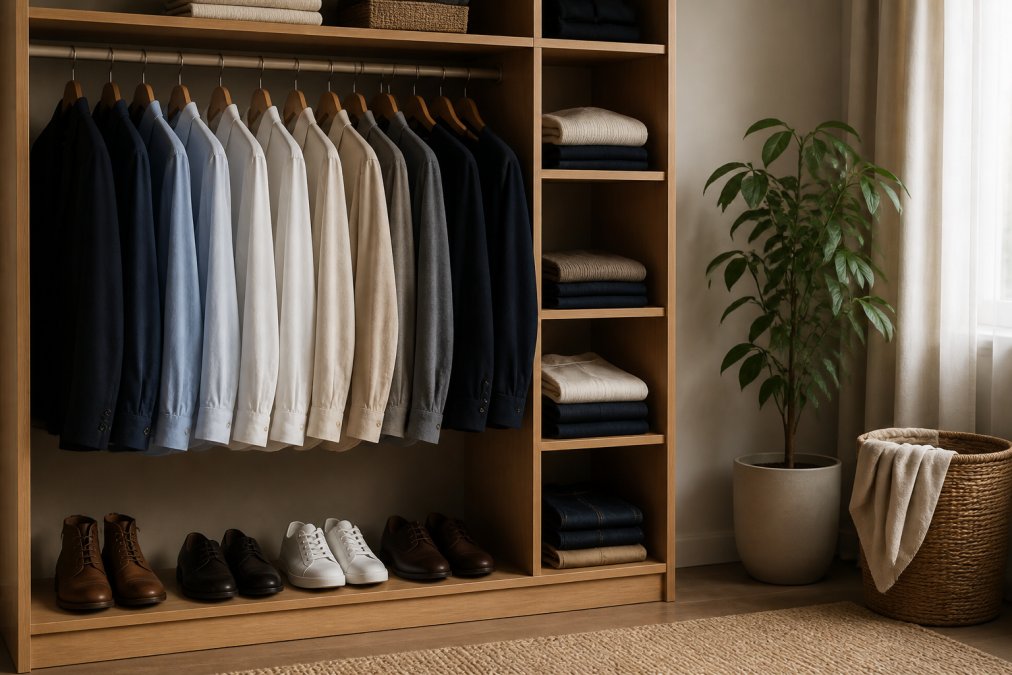
- Two white or light-blue button-down shirts
- One navy blazer
- Two plain crew-neck tees
- One merino sweater
- Two pairs of dark trousers
- One pair of quality denim
- One neutral overcoat
- Three pairs of shoes (see below)
Footwear That Anchors the Whole Rotation
Shoes carry more weight than any other piece. A clean, well-made pair lifts an entire outfit.
Three pairs, three settings, one cohesive rotation.
How to Spot Sustainable Men's Clothing Brands Before You Buy
A sustainable men's clothing brand is one that can show you where its materials come from and how its garments are made. The word "green" on a hangtag means nothing without proof. The Federal Trade Commission's Green Guides exist precisely because vague environmental claims are so common, they set the legal bar for how companies can describe recycled content, organic fiber, and carbon claims in marketing.
Certifications That Actually Carry Weight
Not all logos are equal. These are the ones worth checking, and what each one verifies:
- GOTS (Global Organic Textile Standard): Covers the entire supply chain for organic fiber, farming, processing, manufacturing, and labeling. Requires 70% organic fiber for the "made with organic" label and 95% for "organic." If a brand says "organic cotton" without GOTS or a comparable chain-of-custody certification, treat the claim as unverified.
- OEKO-TEX Standard 100: Tests finished textiles for harmful substances like formaldehyde, heavy metals, and certain azo dyes. It says nothing about farming practices or labor, it's a chemical-safety standard, not a sustainability one.
- Fair Trade Certified (Fair Trade USA): Applies to factories and farms, and requires third-party auditing of wages, hours, and safety. Look for it on cut-and-sew garments where labor conditions are the biggest risk.
- B Corp Certification: A whole-company assessment covering governance, workers, community, environment, and customers. It verifies the business operates to a standard, but does not guarantee any single garment is low-impact.
- bluesign: Focuses on chemical management and resource use in textile mills. Common in performance and outdoor apparel.
Reading a Supply Chain Transparency Report in Five Minutes
A transparency report lists the factories, mills, and farms behind a product. Check three things:
- Tier 1, Final assembly: The cut-and-sew factory. The easiest tier to publish, and where most brands stop.
- Tier 2, Fabric mill: Where the yarn is knit or woven into cloth. Fewer brands publish this.
- Tier 3, Raw material source: The farm, ranch, or recycling facility. Very few brands publish this, and those that do usually name specific suppliers rather than regions.
Five Questions to Ask Before You Buy
If a brand's website doesn't answer these, email customer service. The quality of the reply is itself a signal:
- Where was this garment cut and sewn? A country name is not enough, ask for the factory.
- What is the fiber content by percentage, and is it certified? "Cotton blend" is not an answer.
- Does the brand publish a Tier 2 or Tier 3 supplier list? If not, why not?
- Is there a repair or take-back program? Brands that plan for end-of-life are usually planning for durability too.
- What is the return rate and how are returns processed? High return rates often signal sizing inconsistency, which drives waste.
Greenwashing Red Flags
Watch for these patterns:
Men's Vegan Leather Suede Shoes →
- A single leaf icon with no certification name
- "Eco-friendly collection" language applied to one product line while the rest of the catalog is unchanged
- Recycled content claims with no percentage disclosed
- Carbon-neutral claims that rely entirely on offsets rather than emissions reductions
- A sustainability page that talks about values but never names a supplier, mill, or certification
If a brand can't answer "where was this made?", that's your answer.
Fabric Deep-Dive: Organic Cotton, Tencel, and Recycled Polyester
Fabric choice drives most of a garment's environmental impact, but "natural equals good, synthetic equals bad" is a lazy rule. Every fiber has trade-offs, and the right choice depends on how the garment is worn, washed, and discarded.
Organic Cotton vs. Conventional Cotton
Conventional cotton is one of the thirstiest, most pesticide-intensive crops in the world. Organic cotton is grown without synthetic pesticides and fertilizers and typically uses less water, but it still requires land, water, and energy, and must be spun, dyed, and sewn. A GOTS-certified tee is meaningfully better, not zero-impact.
Tencel (Lyocell) and the Closed-Loop Claim
Tencel is a brand name for lyocell, a fiber made from wood pulp, usually eucalyptus or beech, dissolved in an amine oxide solvent. The process recovers and reuses most of that solvent, hence "closed-loop." The wood typically comes from certified forests, since pulp sourcing is lyocell's real risk.
Recycled Polyester: Better Than Virgin, Not a Free Pass
Recycled polyester (rPET) melts down plastic bottles and re-extrudes them into fiber, displacing virgin petroleum-based polyester. Two caveats:
- It still sheds microplastics every wash. A single synthetic fleece can release hundreds of thousands of microfibers per wash; a guppy bag or filter-equipped machine reduces but does not eliminate that.
- It is not infinitely recyclable. Most mechanical recycling degrades fiber length, so rPET garments are usually downcycled rather than turned back into equal-quality fabric.
Wool, Linen, and the Fibers Competitors Undersell
- Merino wool regulates temperature, resists odor, and needs washing far less often than cotton. Look for non-mulesed sourcing.
- Linen comes from flax, which grows with little water and few inputs, and the whole plant is usable. It softens with age and lasts decades.
- Hemp uses water like linen and resists pests naturally, but is often blended with conventional cotton, diluting the benefit.
The Blends Trap
A 60/40 cotton-poly blend isn't automatically bad, but it's harder to recycle than a single-fiber garment and often pills faster. Single-fiber garments recycle and repair more easily; for stretch, 2-5% elastane is a reasonable trade.
A Practical Decision Framework
Ask three questions in order:
- How often will I wash this? High-wash items (undershirts, gym wear) favor odor-resistant fibers like merino or Tencel. Low-wash items (outerwear, blazers) can justify synthetics.
- How long do I need it to last? Heavier fabrics and single-fiber construction last longer and recycle more easily.
- What happens when it wears out? With no repair path or take-back program, the fiber choice matters less than the disposal problem you're creating.
The Textile Exchange's materials reports track how these fibers perform on carbon footprint and supply chain transparency, and they're worth bookmarking before your next purchase.
Repair, Mending, and End-of-Life Clothing Management
The most sustainable garment is the one you already own. Repair and mending extend longevity and cut textile waste.
Learn four basic fixes:
- Sew a button back on
- Patch a small hole
- Fix a hem with iron-on tape
- Replace a worn sole at a cobbler
- Donate wearable items to charities
- Send worn textiles to recycling programs
- Use brand take-back schemes that turn old fabric into new fiber
Capsule Wardrobes for Specific Climates and Lifestyles
One capsule doesn't fit every life. Your climate and daily routine should shape what you keep.
Frequently Asked Questions
What is the 3-3-3 rule for men's outfits?
The 3-3-3 rule keeps getting dressed fast: three colors maximum per outfit, three distinct layers, and three visible textures. It works because a limited palette forces every piece to coordinate with the rest of your ethical wardrobe. If you are building a capsule of neutral staples, this rule prevents the mismatched purchases that push men back toward fast fashion.
How do I start building a sustainable men's wardrobe on a budget?
Audit what you own first, then fill gaps with secondhand and thrifting before buying new. Set a cost per wear target: a $70 pair of shoes worn twice a week for two years costs about $0.67 per wear. Prioritize versatile layering pieces, and buy one quality item per month instead of several cheap ones. Repair before you replace.
How can I identify high-quality, long-lasting men's apparel?
Check three things: fabric content, stitching density, and hardware weight. Natural fibers like organic cotton and Tencel hold up better than loose synthetic blends. Look for tight, even stitching at stress points and metal zippers or buttons that feel solid. Quality craftsmanship shows in the details, not the label, so inspect the garment before you commit.
How does a capsule wardrobe help reduce environmental impact?
A capsule wardrobe cuts textile waste because you buy fewer, more durable pieces and wear them longer. Garment longevity is the single biggest lever on a wardrobe's carbon footprint. When you mend and rewear instead of replacing, you also reduce demand for new production. A 12-piece core that lasts three years beats 40 fast-fashion items that last one season.
Read more
How to Protect Suede Footwear From Rain and Snow
Learn how to protect suede footwear from rain and snow with waterproofing sprays, salt stain removal, and winter care tips. Keep your shoes pristine all.
Read more
Comfort-Focused Design for Your Online Clothing Store
Discover how comfort-focused design for your online clothing store boosts sales. Learn fabric descriptions, photography, and UX tips to convert browsers.
Read more