
Best Durable Leather Belts for Heavy Duty Everyday Wear
Table of Contents
- Quick Comparison: Durable Leather Belts for Heavy Duty Everyday Wear
- How We Evaluated These Heavy-Duty Leather Belts
- 1. Vinthentic Rustic Cowhide Leather Pin Buckle Belt: Best Overall
- 2. Men's Vintage Classic Casual Belt: Best for Versatile Everyday Styling
- 3. Men's Genuine Leather Automatic Buckle Belt: Best for Business and Formal Wear
- 4. Suede Leather Belt: Best for Casual Jeans and Chinos
- Full Grain Leather Belt Benefits for Heavy Duty Everyday Wear
- Leather Belt Thickness Guide: How Thick Should a Heavy-Duty Belt Be?
- Maintaining Your Leather Belt
- Frequently Asked Questions
Last Updated: September 24, 2026
Quick Comparison: Durable Leather Belts for Heavy Duty Everyday Wear
The best durable leather belts for heavy duty everyday wear share three traits: thick full-grain leather, solid hardware, and reinforced stitching. This guide from Vinthentic breaks down four options built for daily abuse, from a rugged cowhide work belt to a polished ratchet buckle for the office. Investing in these foundational pieces ensures that your wider selection of durable everyday apparel remains functional and comfortable through years of consistent use.
Below you'll find a comparison table, testing criteria, and a thickness guide so you can match the belt to the job.
| Belt | Price | Material | Buckle | Best For |
|---|---|---|---|---|
| Vinthentic Rustic Cowhide Pin Buckle | $99.99 | Full-grain cowhide | Copper pin | Heavy duty everyday wear |
| Men's Vintage Classic Casual Belt | $47.95 | Leather | Classic buckle | Versatile everyday styling |
| Men's Genuine Leather Automatic Buckle | $38.95 | Cowhide + zinc alloy | Ratchet | Business and formal wear |
| Suede Leather Belt | $39.99 | Suede leather | Classic pin | Casual jeans and chinos |
How We Evaluated These Heavy-Duty Leather Belts
We judged each belt on four things: leather type, thickness, hardware quality, and stitching.

- Leather type: full-grain and vegetable-tanned hides score highest for tensile strength
- Thickness: heavier straps resist sag and hole elongation
- Hardware: solid brass or stainless steel buckles outlast plated zinc
- Stitching: reinforced, double-row stitching prevents edge separation
1. Vinthentic Rustic Cowhide Leather Pin Buckle Belt: Best Overall
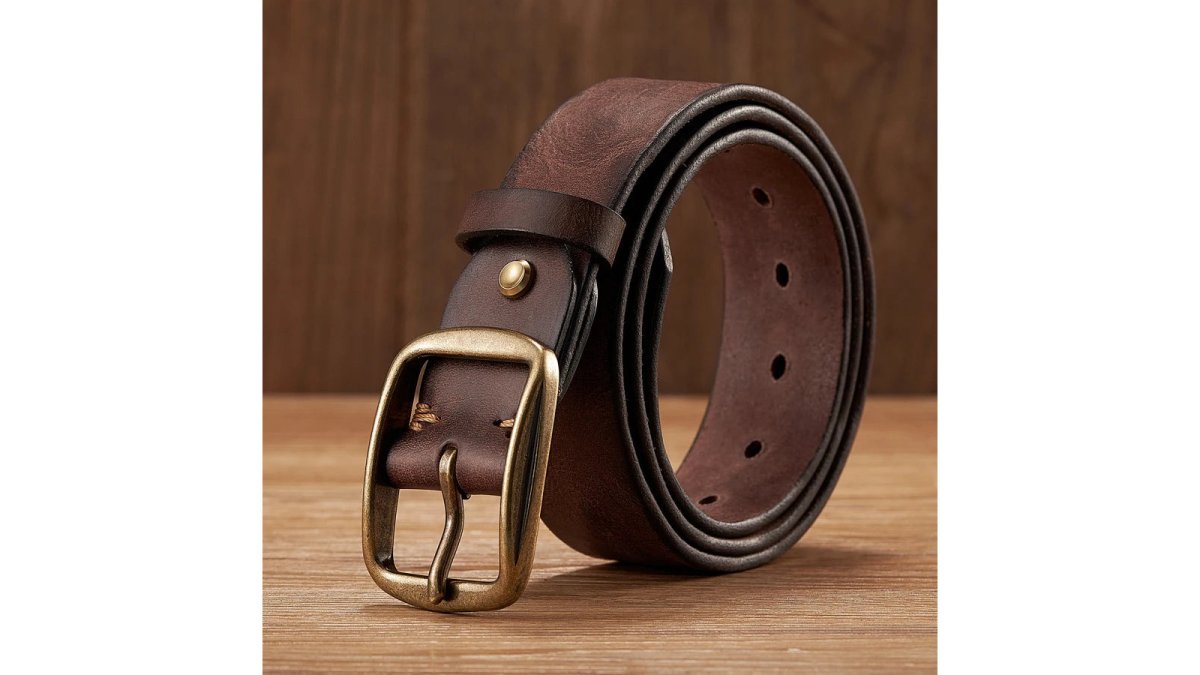
Our top pick is the Vinthentic Rustic Cowhide Leather Pin Buckle Belt. It uses thick full-grain cowhide with a vintage copper pin buckle, exactly the combination that survives heavy duty everyday wear.

The 3.8cm width feels substantial without looking bulky. Full-grain cowhide keeps its structure, while the copper pin buckle locks in place and develops a patina over time.
Where it falls short: at $99.99 it costs more than the other three picks. That price buys the full-grain hide and copper hardware.
2. Men's Vintage Classic Casual Belt: Best for Versatile Everyday Styling
The Men's Vintage Classic Casual Belt is the most flexible option here, pairing a classic buckle with a vintage design that works with jeans, trousers, and semi-formal outfits alike.

At $47.95, it's mid-pack on price and the easiest to wear across settings, office to weekend without swapping belts.
The drawback: it's less specialized than the cowhide pick. If your routine involves heavy loads or constant abrasion, the thicker full-grain strap may be more suitable.
3. Men's Genuine Leather Automatic Buckle Belt: Best for Business and Formal Wear
The Men's Genuine Leather Automatic Buckle Belt offers a precise fit.
At $38.95, it's the lowest-priced belt in this comparison and the most polished for office wear.
4. Suede Leather Belt: Best for Casual Jeans and Chinos
The Suede Leather Belt is the casual specialist. Suede has a softer hand than smooth leather and pairs naturally with denim and chinos for a relaxed, textured look.
Full Grain Leather Belt Benefits for Heavy Duty Everyday Wear
Full-grain leather keeps the entire hide intact, including the grain side. The reason goes deeper than the surface layer, it comes down to fiber structure and tanning.
The fiber structure behind the strength
Leather is a dense weave of collagen fibers. Near the grain side, fibers are tightly packed in a crisscross pattern; toward the flesh side they loosen and run parallel. Sanding off the grain to hide scars, producing corrected-grain leather, removes part of the hide. Bonded leather is shredded scraps glued to a backing, with no continuous fiber structure.
Vegetable-tanned vs. chrome-tanned: which holds up longer?
Most belts are chrome-tanned. The process is fast, often a day or two, using chromium salts to stabilize the hide, yielding soft, uniform, cheap leather that dominates fashion belts.
Vinthentic Rustic Cowhide Leather Pin →
What to expect during break-in
A 10-12 oz full-grain belt will feel stiff for the first one to three weeks. The leather warms against your body, fibers relax at the fold points, and the strap molds to your waist, fitting better than it did new.
A few habits may make break-in easier:
- Wear it daily. Consistent body heat and movement loosen the leather faster than occasional wear.
- Do not force the bend. Sharp folding or bending the strap backward can crack the grain before the fibers have relaxed.
- Condition lightly. A thin coat of conditioner at the buckle fold speeds break-in. Over-oiling softens the leather and can stretch the strap.
For heavy duty everyday wear, vegetable-tanned full-grain leather at 10-12 oz is a strong option. It keeps the dense grain-side fibers, and may resist both tensile stretch and flex cracking.
Leather Belt Thickness Guide: How Thick Should a Heavy-Duty Belt Be?
Thickness is an important predictor of how a belt ages under daily load. Leather is sold by weight in ounces per square foot, and that number maps directly to strap thickness in millimeters.
Here is the working range for men's belts:
- 4-6 oz (roughly 1.6-2.4 mm): dress and fashion belts. Light, flexible, and not built to carry anything.
- 7-9 oz (roughly 2.8-3.6 mm): mid-weight casual and business belts. Fine for a phone clipped to the waist, not for a tool pouch.
- 10-12 oz (roughly 4.0-4.8 mm): work-grade and heavy-duty everyday belts. This is the range that resists sag and hole stretch.
- 13-14 oz (roughly 5.2-5.6 mm): heavy harness and gun-belt territory. Extremely stiff, slow to break in, and overkill for most daily wear.
Why thickness decides where a belt fails
A belt often fails at one of two points, and thickness can influence both.
How much weight can a heavy-duty belt actually carry?
A 10-12 oz full-grain strap at 1.5 inches wide, worn snug, may support a loaded tool pouch in the 5-10 lb range daily without visible sag. Push past roughly 15 lb on one side and the strap may tilt and the top edge roll.
Two habits may help:
- Wear the belt snug, not tight. A snug fit keeps the strap flat against your body so the load rides on your hips, not on a stretched hole.
- Distribute the load. A pouch centered on one hip pulls the belt sideways. Splitting weight between two pouches keeps the strap level and roughly doubles how much it carries comfortably.
For heavy duty everyday wear, look for 10-12 oz full-grain leather at roughly 1.5 inches wide. That combination may handle a 5-10 lb daily load, and may resist hole elongation.
Maintaining Your Leather Belt
Leather conditioning can help maintain a belt. A simple routine may keep the hide supple and slow wear at the buckle and holes.
- Wipe the belt with a dry cloth after heavy use to remove sweat and grit
- Apply a leather conditioner every few months, more often in dry climates
- Let the belt rest between wears; moisture from daily use may weaken leather over time
- Store it rolled or hanging, never folded, to avoid permanent creases
Frequently Asked Questions
What type of leather belt is the most durable?
Full-grain leather is the most durable option because it keeps the hide's natural grain intact, giving it higher tensile strength and better resistance to cracking than top-grain, split, or bonded leather. A full-grain belt with reinforced stitching and solid brass or stainless steel hardware handles daily wear and weight-bearing use far better than corrected-grain alternatives. Thickness matters too: aim for at least 3.5mm to 4mm for heavy-duty everyday wear.
How can you tell if a leather belt is high quality?
Check the grain side for visible natural pores and slight variations rather than a uniform plastic-like surface. Look at the flesh side: genuine full-grain leather shows a suede-like texture, while bonded leather reveals a fabric backing. Inspect the stitching for tight, even lines, and confirm the buckle is solid brass or stainless steel, not plated zinc. A leather belt thickness guide can help you confirm the strap is substantial enough for daily use.
What is the best heavy duty work belt for everyday wear?
The best heavy-duty work belt combines full-grain cowhide, a strap width of 3.5cm to 3.8cm, and a pin or ratchet buckle made from solid metal. The Vinthentic Rustic Cowhide Leather Pin Buckle Belt, for example, uses thick full-grain cowhide and a vintage copper pin buckle at $99.99, making it a strong fit for jeans and rugged daily wear. For a lighter option that still holds up, the Suede Leather Belt at $39.99 works well for casual settings.
How do I maintain leather belts so they last longer?
Wipe the belt with a dry cloth after wear to remove oils and dust, then condition it every three to six months with a leather conditioner to prevent drying and cracking. Store it rolled rather than hanging to avoid stretching the holes. Keep it away from prolonged heat and moisture, which may accelerate hole elongation and hardware failure. Rotating between two or three durable leather belts may also extend the life of each one.
How long does a heavy-duty leather belt take to break in?
A full-grain leather belt typically takes two to four weeks of regular wear to break in. The leather softens and molds to your waist, and the strap develops a patina that deepens over time. Expect some initial stiffness, especially with thicker cowhide. Avoid forcing the break-in by over-bending the strap, which may weaken the fibers near the buckle and shorten the belt's usable life.
Read more

How to Dress Stylishly While Staying Comfortable
Learn how to dress stylishly while staying comfortable. Explore fabric choices, capsule wardrobe essentials, and styling tips that keep you polished all.
Read more
Is Vintage Leather Jacket Quality Worth the Price?
Is vintage leather jacket quality worth the price? We break down cost-per-wear, restoration costs, and what to check before buying. Discover the real.
Read more