

Premium Quality Products for Slow Fashion: 2026 Guide
Table of Contents
- What Separates Premium Quality Products for Slow Fashion From Fast Fashion
- How to Identify High-Quality Clothing Before You Buy
- Sustainable Capsule Wardrobe Essentials Worth the Investment
- How to Care for Premium Apparel So It Lasts for Years
- Repair and Maintenance: Extending the Life of Premium Pieces
- Second-Hand Premium Marketplaces: Where Slow Fashion Finds a Second Life
- Why Premium Quality Products for Slow Fashion Cost More Upfront
- Frequently Asked Questions
Last Updated: September 27, 2026
What Separates Premium Quality Products for Slow Fashion From Fast Fashion
The difference comes down to construction, materials, and intent. Premium quality products for slow fashion are built to be worn for years, while fast fashion is designed to be replaced within a season.
At Vinthentic, we understand the importance of genuine quality and lasting style. Our customers often ask about the authenticity of our materials, the longevity of our designs, and how our pieces can integrate into a cohesive wardrobe.
Slow fashion is a production philosophy that prioritizes durability, ethical manufacturing, and timeless design over rapid trend cycles. It trades volume for longevity.
The Ellen MacArthur Foundation's circular economy research has documented how much textile waste comes from short-life garments. The core problem isn't price. It's that most shoppers never learned what to look for.
Below, we break down exactly how to identify quality before you buy, plus which pieces deserve a spot in your rotation.
How to Identify High-Quality Clothing Before You Buy
Start with the fabric content label, then inspect the construction. A garment's tag tells you more about its lifespan than any marketing claim.
Check these markers:
- Fiber content: Look for genuine leather. Blends with high synthetic percentages wear out faster.
- Weight and hand feel: Premium fabric has density. Thin, papery material rarely survives repeated washing.
- Lining quality: A cheap lining is the first thing to tear. Bemberg or cupro linings outlast polyester by years.
- Hardware: Metal zippers and reinforced buttons signal investment pieces. Plastic hardware cracks.
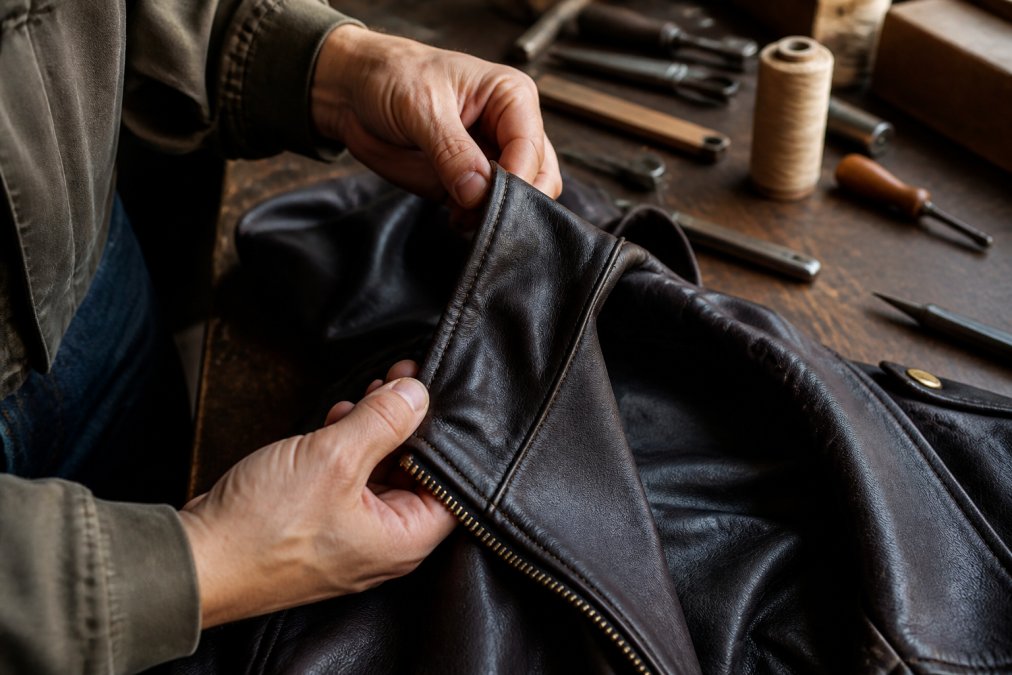
Stitching, Seams, and Hardware: The Three-Point Check
Run your fingers along three zones: the shoulder seam, the side seam, and the hem. Tight, even stitches with no loose threads indicate quality craftsmanship.

A common mistake is ignoring the inside of a garment. Turn it inside out. Finished seams, clean overlocking, and no raw edges mean the maker expected it to last.
Sustainable Capsule Wardrobe Essentials Worth the Investment
Build around pieces that work across seasons and settings. A sustainable capsule wardrobe typically runs 20-30 items, each earning its place through versatility.
For a professional wardrobe, start with these staples:
- A genuine leather jacket for layering year-round. The Retro Faded Cowhide Genuine Leather Jacket ($357.00) uses top-layer genuine cowhide with a stand collar and slim fit.
- A wool outer layer. The Giulio Romano Premium Wool Jacket ($79.99) is tailored from fine wool with a design that transcends trend cycles.
- Knitwear in neutral tones. The Sandro Botticelli Premium Sweater ($39.99) uses a cashmere blend for softness and warmth.
- A premium t-shirt. The Essential Classic T-shirt ($29.99) is made from premium cotton with timeless design.
- A lightweight pullover. The Florentine Premium Knit Pullover ($49.99) uses 100% cotton with premium Italian design.
The Cost-Per-Wear Math That Changes Everything
Cost-per-wear is the purchase price divided by the number of times you wear an item. A $30 shirt worn five times costs $6 per wear. A $150 jacket worn 200 times costs $0.75.


That formula reframes the entire buying decision. A cheaper garment you replace twice a year often costs more over a decade than one well-made piece.
How to Care for Premium Apparel So It Lasts for Years
Care determines whether an investment piece lasts three years or fifteen. The rules differ by fiber because each fiber fails for a different reason. Match the routine to the failure mode.
Leather: Wipe with a damp cloth after wear, then condition twice a year with a pH-balanced leather cream. Store on a wide hanger away from direct sun and radiators. Never machine wash or submerge genuine leather, and never dry it with heat, which shrinks the hide and sets creases permanently. If the jacket gets soaked, blot it and let it air-dry at room temperature, away from any heat source.
Wool: Hand wash cold with a wool-safe detergent, or dry clean. The key mechanism is avoiding agitation, which makes the fiber scales lock together and shrink the garment irreversibly. Air wool between wears so moisture evaporates and the fibers recover their loft. Store folded, not hung, because a shoulder seam under a heavy knit's own weight will stretch and never spring back.
Cotton knits: Wash inside out in cold water on a gentle cycle, then lay flat to dry. Heat is the enemy of garment longevity because it relaxes the fiber and accelerates shrinkage and pilling. If you must tumble dry, use the lowest setting and pull the garment back into shape while it is still damp.
Cashmere blends: Use a mesh bag for washing, and de-pill with a cashmere comb rather than a razor. A razor cuts the fiber and creates a new pill within weeks; a comb lifts the loose ends without shortening the staple. Wash cashmere as rarely as possible, and spot-clean between full washes.
Decode the care tag before you wash anything. The five symbols on a standard care label map to specific actions: a washtub means machine wash, a triangle means bleach, a square means dry, an iron means heat, and a circle means dry clean. A single line under a symbol means a gentler cycle; two lines mean the gentlest. A crossed-out symbol means do not do it. Reading the tag takes ten seconds and prevents the most common cause of premature garment death: a hot wash on a wool sweater.
The American Cleaning Institute's fabric care guidance outlines how fiber-specific routines extend garment life, and the Federal Trade Commission's care labeling rule requires permanent care instructions on most textile garments, which means the tag is a legal disclosure, not a suggestion.
Repair and Maintenance: Extending the Life of Premium Pieces
Most quality garments can be repaired for a fraction of replacement cost. A skilled tailor can re-stitch a seam, replace a zipper, or reinforce a lining for far less than buying new. The gap most guides leave open is the decision itself: when is repair worth it, and when is it throwing money at a garment that has already failed structurally?
The repair-versus-replace test. Repair makes sense when the fabric is sound and the failure is in the construction: a seam, a zipper, a button, a lining, a hem.
What's worth repairing:
- Loose or split seams on jackets and trousers
- Zipper replacement on outerwear
- Lining replacement in wool coats
- Button and hardware reattachment
- Re-stitching a dropped hem
- Reinforcing a shoulder seam before it fails
Questions to ask when you vet a repair shop:
- Do you do this repair in-house, or send it out?
- What is the turnaround time?
- Do you guarantee the repair, and for how long?
- Can you show me a similar repair you have done?
Second-Hand Premium Marketplaces: Where Slow Fashion Finds a Second Life
The resale market has become a legitimate channel for premium apparel. Well-made pieces hold value, which means buyers can access quality at lower entry prices.
For shoppers new to resale, three rules help:
- Buy from sellers with detailed photos and return policies
- Request the original fiber content tag
- Avoid listings that use vague terms like "premium feel" without specifics
Why Premium Quality Products for Slow Fashion Cost More Upfront
Higher prices reflect real costs: better raw materials, smaller production runs, and fair labor. Small-batch production doesn't benefit from the economies of scale that drive fast fashion pricing.
| Factor | Fast Fashion | Premium Slow Fashion |
|---|---|---|
| Typical lifespan | 1-2 seasons | 5-10+ years |
| Materials | Synthetic blends | Wool, genuine leather |
| Production scale | Mass, high volume | Small-batch |
| Repair viability | Rarely worth it | Often cost-effective |
| Cost-per-wear | High over time | Low over time |
Frequently Asked Questions
What defines premium quality in slow fashion garments?
Premium quality in slow fashion comes down to three things: materials, construction, and longevity. Look for genuine leather or wool rather than synthetic blends. Check stitching density, seam finishing, and hardware weight. A premium garment should hold its shape after repeated wear and washing. The real test is cost-per-wear: a $357 genuine cowhide jacket worn 200 times costs $1.79 per wear, far less than a $60 fast-fashion jacket worn five times.
How can you tell if a clothing brand is truly sustainable?
Ask three questions: Where was it made? What is it made from? Can the brand prove it?
What are the best materials for long-lasting, ethical clothing?
Genuine leather, premium wool, and cashmere blends top the list. These materials age well, resist pilling, and maintain structure over years of wear. Leather develops a patina that many consider more attractive than new. Wool regulates temperature and resists odors. Ask for the material breakdown before buying.
How do you build a capsule wardrobe with premium essentials?
Start with 10 to 15 pieces that mix and match across seasons. Choose neutral colors and timeless silhouettes. Invest in quality craftsmanship over quantity. A genuine leather jacket, a premium wool sweater, and a classic t-shirt form the core. Add pieces gradually, replacing fast-fashion items as they wear out. The goal is a wardrobe where every item earns its place through frequent wear and lasting durability.
The challenge isn't finding premium quality products for slow fashion. It's knowing how to spot them before you spend. Vinthentic builds around genuine leather craftsmanship, handcrafted precision, and timeless footwear and apparel designed for everyday comfort. With over 20,000 happy customers, the proof sits in wardrobes that keep working year after year. Shop now and start building a rotation that outlasts the trend cycle.
Read more
5 Best Eco-Friendly Men's Workwear Brands for 2026
Discover the 5 best eco-friendly men's workwear brands for 2026. Compare pricing, durability, and ethical standards. Find your sustainable work wardrobe.
Read more
5 Stylish Relaxed Fit Trousers for Men: 2026 Guide
Discover 5 stylish relaxed fit trousers for men in 2026. Compare fits, fabrics, and prices to find your perfect pair. Explore the best relaxed fit.
Read more