Article: How to Care for Men's Knitwear at Home
How to Care for Men's Knitwear at Home
Table of Contents
- Why fibre content decides your wash method
- How to Hand-Wash a Sweater Step by Step
- How to Dry a Sweater Without Stretching It
- How to Remove Pilling from Sweaters
- How to Store Sweaters Between Seasons
- Building a Between-Wash Routine for Your Knitwear Wardrobe
- Frequently Asked Questions
Read the Care Label and Identify the Fibre
how to care for men's knitwear starts with one small piece of fabric: the care label sewn into the side seam. Before you wash, dry or store any sweater, read that label and find the fibre content. That single step decides your wash method, your water temperature and how much risk your favourite knit faces.
Most labels list the fibre percentages, such as 100% merino wool or 80% cotton and 20% nylon. The care symbols beside them show what the garment can handle: a tub for washing, a triangle for bleach, a square for drying. Learn to read these few symbols and you avoid most of the damage that ruins men's knitwear.
Watch out: A sweater with no label, or a label that has worn away, is not a free pass to machine wash. Treat it as delicate and hand-wash it until you know the fibre.
Why fibre content decides your wash method
Natural fibres such as wool, cashmere and merino felt when agitated in heat. The scales on each fibre lock together, and the knit shrinks and thickens. Cotton and synthetic blends behave differently. They tolerate more agitation but can stretch out of shape when wet and heavy.
This is why one wash method cannot fit every sweater in your drawer. A 100% wool crew neck needs cool water and a gentle hand. A cotton-blend cardigan can often take a gentle machine cycle. Matching the method to the fibre is the core skill in caring for men's knitwear.
Here is a quick guide to match common fibres to a wash approach:
| Fibre content | Best wash method | Water temperature | Drying |
|---|---|---|---|
| 100% wool or merino | Hand wash | Cool to lukewarm | Flat, away from heat |
| Cashmere | Hand wash | Cool | Flat, reshape gently |
| Cotton or cotton blend | Gentle machine cycle or hand wash | Cool | Flat |
| Acrylic or synthetic blend | Gentle machine cycle | Cool | Flat or low tumble |
How to Hand-Wash a Sweater Step by Step
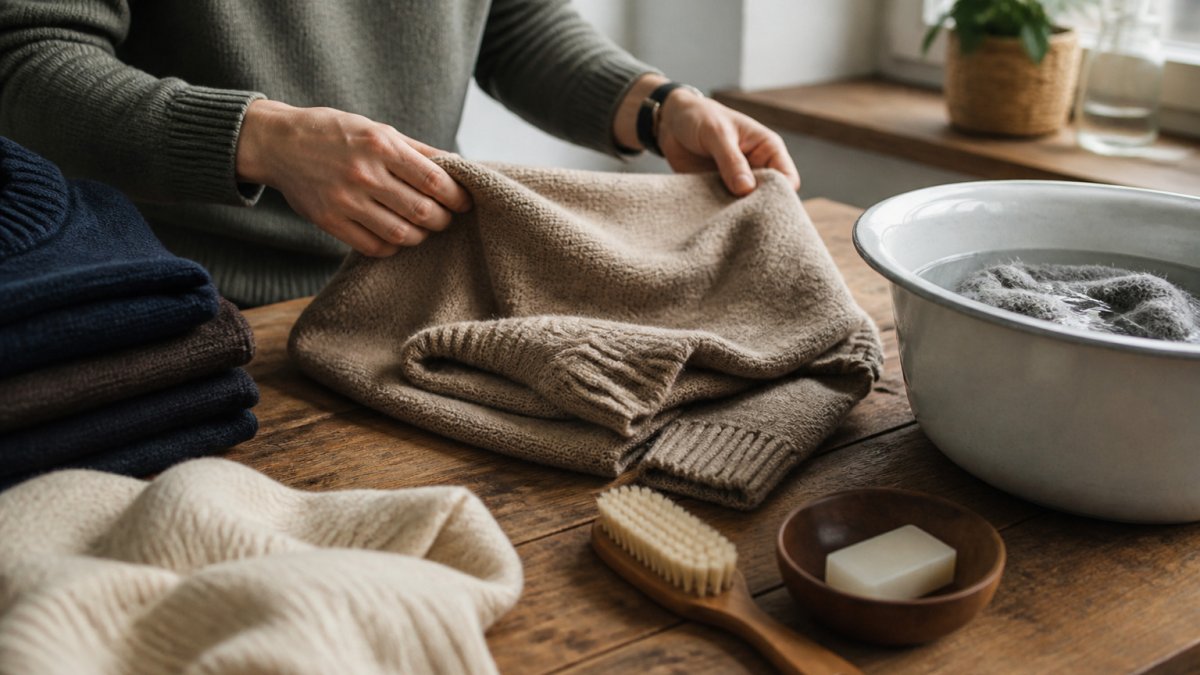
Hand washing is the safest method for most men's knitwear. It takes about 15 minutes of active work and protects the shape and softness of the knit. Gather a clean basin, a mild wool detergent and a towel before you begin.
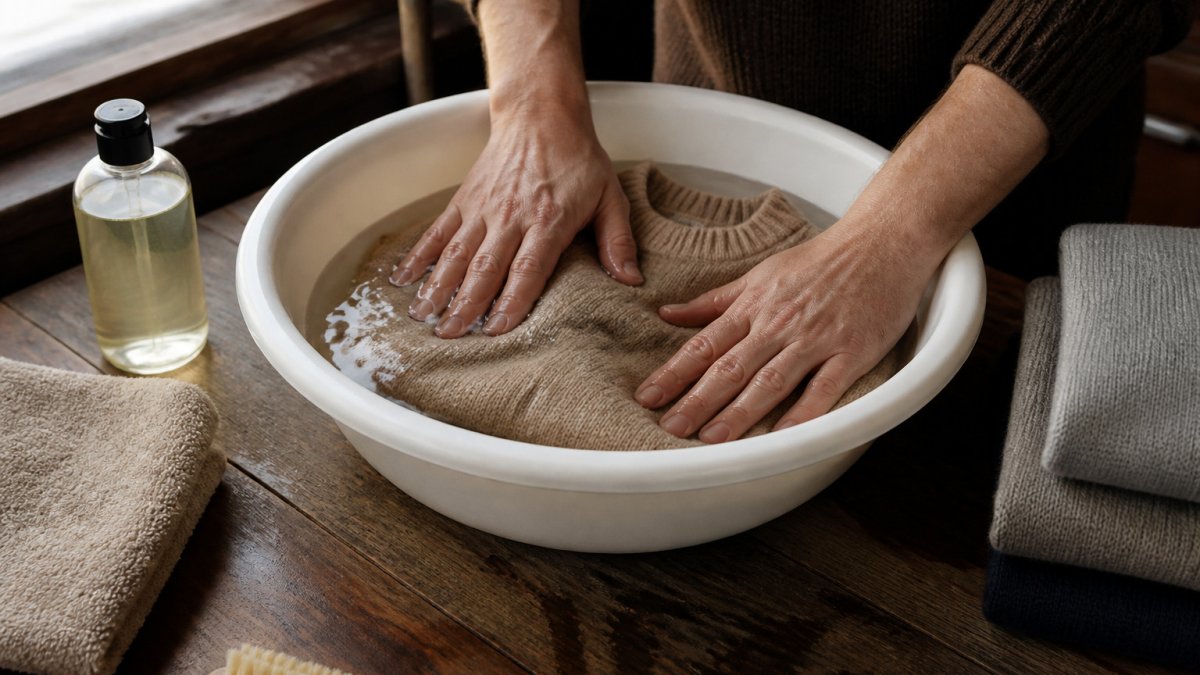
Follow these steps in order:
- Fill a basin with cool or lukewarm water and add a small amount of mild wool detergent.
- Submerge the sweater fully and press it gently for two to three minutes. Do not rub or wring.
- Let it soak for about 10 minutes so dirt loosens from the fibres.
- Drain the water, then press the sweater against the side of the basin to squeeze out moisture.
- Refill with clean water at the same temperature and rinse until no suds remain.
- Lay the sweater on a dry towel, roll the towel up and press to remove more water.
- Reshape the sweater by hand and lay it flat on a clean, dry towel to dry.
Many people make the mistake of wringing the sweater like a shirt. Wringing twists the fibres and stretches the knit, which can leave permanent bulges at the shoulders. Pressing and rolling in a towel removes water without distorting the shape.
Choosing water temperature and a gentle detergent
Water temperature matters more than most people expect. Hot water causes wool to shrink and felt, and it can fade dyes. Stick to cool or lukewarm water for every natural fibre, and reserve warmer water for cotton-only items that the care label allows.
A mild wool detergent or a pH-neutral soap is the right choice. Harsh detergents strip natural oils from wool and leave the fibres dry and brittle. Skip bleach entirely, and avoid fabric softeners, which can coat the fibres and reduce their natural loft.
When machine washing is acceptable
Machine washing is acceptable only when the care label allows it. Use a gentle or wool cycle, cold water, a mesh laundry bag and a mild detergent. Keep the load small so the sweater has room to move without tangling.
Machine washing still carries more risk than hand washing. Even on a gentle cycle, agitation can cause pilling and stretching. If the label says "hand wash only" or shows a crossed-out tub, follow it.
How to Dry a Sweater Without Stretching It
Drying is where many good sweaters are ruined. A wet knit is heavy, and hanging it causes the shoulders to stretch and the hem to drop. The fix is simple: always dry sweaters flat.
Lay the sweater on a clean, dry towel or a mesh drying rack. Gently shape the body, sleeves and collar to their original measurements. Keep it away from direct sunlight and radiators, because heat can shrink wool and fade colours. Check it after 24 hours, and turn it over once if the underside is still damp.
Watch out: Never tumble dry a natural-fibre sweater, even on low heat. The heat and tumbling felt wool and can shrink it by a full size.
How to Remove Pilling from Sweaters
Pilling is the small fuzzy balls that form on the surface of a sweater from friction. It is normal, especially on wool and blends, but it makes a good knit look worn. You can prevent much of it by washing gently and turning the sweater inside out, and you can remove the rest with the right tool.
How to Store Sweaters Between Seasons
Storage protects your knitwear from moths, dust and stretching. Clean every sweater before you store it, because moths are drawn to body oils and food stains. Fold each sweater neatly rather than hanging it, since hanging stretches the shoulders over months.
Store folded sweaters in breathable cotton bags or on shelves, not in plastic bags, which trap moisture. Keep the storage area cool and dry.
A pre-storage inspection for men's knitwear
Before a sweater goes into storage, inspect the features that take the most wear: the collar, the cuffs, the ribbed hem and the shoulder seams. These are the places where men's knitwear fails first, and catching a small problem before storage saves the garment.
- Collar: Check for stretching or curling. A collar that has lost its shape can be reshaped while damp before storage.
- Cuffs and hem: Look for thinning ribbing or loose yarn. Ribbing that has stretched can be tightened by hand while damp and dried flat.
- Shoulder seams: Check for popped stitches or a stretched seam. A small repair now prevents a larger hole later.
- Underarms: Look for pilling and odour. Clean these areas before storage so moths are not attracted.
Repairing common damage before storage
Small damage is easier to fix before storage than after. A loose thread, a snag or a small hole can be stabilized in a few minutes and will not grow while the sweater sits in a drawer.
- Loose thread: Do not pull it. Use a blunt needle to work the thread back into the knit on the wrong side, then tie it off gently.
- Snag: Pull the snag to the inside with a crochet hook, then distribute the excess yarn across neighbouring stitches with a needle.
- Small hole: Use a matching-colour wool yarn and a blunt needle to duplicate-stitch across the hole, following the path of the original stitches.
- Stretched cuff: Wet the cuff, reshape it by hand to its original size and dry it flat. Ribbing has memory and often recovers.
Storing by fibre and construction
Different fibres need slightly different storage conditions. Wool and cashmere are the most attractive to moths, so they need the most protection. Cotton and synthetics are less vulnerable but can still pick up dust and odour.
- Wool and cashmere: Store in breathable cotton bags with cedar or lavender. Check monthly for moth activity.
- Cotton: Fold and store on a shelf; cotton is heavier and can stretch if hung.
- Synthetics: Store folded; synthetics hold static and attract dust, so a breathable bag helps.
- Structured shoulders: Do not stack heavy sweaters on top of a structured shoulder; the weight can flatten the shape over months.
Between-season rotation
Rotate your storage so no sweater sits at the bottom of a pile for years. A simple pattern is to store the heaviest winter knits at the back and the lighter layers at the front, then reverse the order when the seasons change. This spreads the wear and gives you a chance to inspect each sweater once a year.
Building a Between-Wash Routine for Your Knitwear Wardrobe
Most knitwear does not need washing after every wear. A good routine saves the fibres from unnecessary handling. Air each sweater out after wearing it, and let it rest for a day before putting it back in the drawer.
Spot clean small marks with a damp cloth and a drop of mild detergent, rather than washing the whole garment. Rotate your sweaters so none gets worn every day. This spreads the wear across your wardrobe and extends the life of each piece.
Follow this simple routine to keep your knitwear in shape:
- Air out each sweater after every wear
- Spot clean stains as soon as you notice them
- Hand wash only when the piece is genuinely soiled
- Rotate your knitwear so no single sweater takes all the wear
- Check for pilling and moths at the change of each season
Caring for men's knitwear is less about effort and more about consistent, gentle habits. Read the label, match the method to the fibre and dry flat every time, and your sweaters will keep their shape and softness for years.
Frequently Asked Questions
How often should you wash men's knitwear?
Wash knitwear only when it is visibly soiled or has picked up odor, because frequent washing wears fibres down. Between washes, airing the sweater out for a day, brushing off lint and spot-treating small marks keeps it fresh. Heavier-use pieces such as a daily-wear cardigan may need washing a few times a season, while a rarely worn knit can go much longer.
Can you machine-wash men's sweaters?
Only if the care label allows it, and even then use a gentle or wool cycle with cold or lukewarm water and a mild detergent. Place the sweater in a mesh laundry bag to reduce friction. Hand washing remains the safer choice for fine merino, cashmere and blends, since machine agitation is the main cause of felting, stretching and pilling.
How do you dry a sweater without stretching or shrinking it?
Lay the sweater flat on a clean towel, roll the towel gently to press out excess water, then reshape the garment by hand. Keep it flat on a mesh rack away from direct sunlight and heat sources. Never hang a wet knit, because the weight of the water pulls the shoulders and hem out of shape.

Read more
5 Steps to Layer for Transitional Weather Like a Pro
Transitional weather layering keeps you comfortable from a 45°F morning to a 68°F afternoon. Remove pieces as you warm up, and carry them when you do.
Read more