
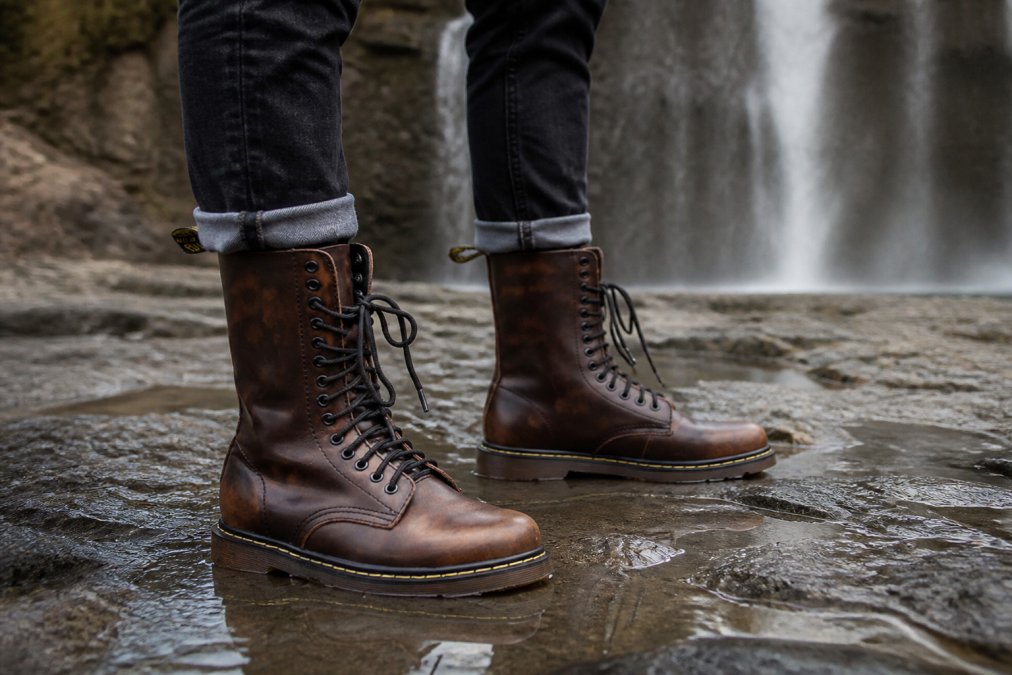
Best Quality Leather Boots for Men: 2026 Guide
Table of Contents
- What Separates Quality Leather Boots from the Rest
- Full-Grain vs Top-Grain Leather Boots: Which Should You Buy?
- Goodyear Welt Construction Benefits Explained
-
Best Quality Leather Boots for Men: Our Top Picks
- Walker Evans Full Grain Leather Boots, Best All-Rounder ($89.99)
- Vittorio Avanzi Leather Chelsea Boots, Best for the Office ($69.99)
- Umberto Basso Cap-Toe Chelsea Leather Boots, Best Dress Boot ($69.99)
- Cedric Leblanc Combat Chelsea Boots, Most Rugged Option ($69.99)
- Bernardo Cavallino Leather Chelsea Boots, Best Entry Price ($64.99)
- Sizing, Fit, and Break-In Period: What to Expect
- How to Care for Leather Boots So They Last for Years
- Quick Comparison: Which Boot Fits Your Lifestyle?
- Conclusion
Last Updated: August 22, 2026
Most men buy leather boots the wrong way. They focus on color, silhouette, or price, and ignore the three things that actually determine whether a boot lasts three years or three decades: leather grade, sole construction, and repairability. At Vinthentic, we've curated boots that pass all three tests. This guide breaks down exactly what separates a quality leather boot from an expensive disappointment.
The best quality leather boots for men aren't necessarily the most expensive ones on the market. They're the ones built with full-grain leather uppers, welted construction, and soles a cobbler can actually work with.
Quick Picks:
- Best All-Rounder: Walker Evans Full Grain Leather Boots ($89.99), full-grain leather, versatile design
- Best for the Office: Vittorio Avanzi Leather Chelsea Boots ($69.99), premium Italian leather, cushioned insole
- Best Dress Boot: Umberto Basso Cap-Toe Chelsea Leather Boots ($69.99), cap-toe detailing, refined silhouette
- Most Rugged: Cedric Leblanc Combat Chelsea Boots ($69.99), slip-resistant outsole, reinforced stitching
- Best Entry Price: Bernardo Cavallino Leather Chelsea Boots ($64.99), genuine leather, all-day comfort
What Separates Quality Leather Boots from the Rest
Quality leather boots are defined by three elements: leather grade, sole construction, and structural support. A boot that excels in all three will outlast cheaper alternatives by years, develop a richer patina, and remain serviceable through a cobbler long after lesser boots are discarded.

Most guides stop at "look for genuine leather." That's not enough. The term "genuine leather" is technically the lowest rung of real leather products. The details that actually matter are explained below.
Leather Upper and Grain: The First Thing to Check
Full-grain leather is the outermost layer of the hide, left intact with its natural grain pattern. It is the most durable leather type, resists moisture better than processed alternatives, and develops a distinctive patina as it ages.
Top-grain leather is sanded and buffed to remove imperfections, then coated with a finish. It looks more uniform but lacks the breathability and long-term aging character of full-grain.
Below those two are nubuck and suede, which offer softer texture at the cost of water resistance and durability. Oil-tanned leather is saturated with oils during tanning, giving it natural water resistance and a supple feel from day one. Calfskin combines fine grain texture with meaningful durability, making it preferred for dress boots.
Sole Construction, Shank, and Ankle Support
The sole is where most budget boots cut corners, and where the long-term ownership story begins.
A shank is a rigid strip, typically steel or fiberglass, embedded between the insole and outsole. It prevents the arch from collapsing under load and separates a boot that feels supportive after eight hours from one that leaves your feet aching by noon.
Lug soles offer aggressive traction through deep rubber channels, suited for outdoor use. Crepe soles, made from natural rubber latex, provide cushioning and grip on smooth surfaces. Both are resoleable by a skilled cobbler, which is critical for long-term value.
Ankle support in a Chelsea boot comes from the boot's height, the stiffness of the leather upper, and the fit around the ankle panel. A well-fitted Chelsea should hold the ankle firmly without pinching.
Full-Grain vs Top-Grain Leather Boots: Which Should You Buy?
Full-grain leather boots are the better long-term investment for most men. Full-grain retains the hide's natural fiber structure, which means greater tensile strength, superior moisture resistance, and the ability to develop a patina that improves the boot's appearance over time.
The practical difference shows up around the two-year mark. Full-grain boots worn regularly develop character: slight creasing at the flex point, deepened color where conditioned, and a surface that tells the story of where they've been. Top-grain boots at the same age tend to show wear less gracefully, with the surface coating beginning to crack or peel rather than patina.
For men who wear boots daily to the office or on varied terrain, full-grain is the clear choice. One caveat: full-grain requires more maintenance. Without regular conditioning, even the best full-grain leather will dry out and crack. The payoff is a boot that, properly cared for, can last a decade or more.
According to Leather Industries of America's leather quality guide, full-grain leather is the highest quality grade available and the only type that improves in appearance with age and proper care.
Goodyear Welt Construction Benefits Explained
Goodyear welt construction is the gold standard for resoleable leather boots. In a Goodyear welt, the upper leather, an insole, and a strip of leather or synthetic material called the welt are all stitched together in a single pass. The outsole is then stitched to that welt separately.
The result: the outsole can be removed and replaced without disturbing the upper or insole. A skilled cobbler can resole a Goodyear welted boot multiple times over its life, effectively making a well-maintained pair last indefinitely.
Stitch-down construction is the other welted method worth knowing. The upper is folded outward and stitched directly to the outsole. Stitch-down boots tend to be wider and more casual, with excellent durability and resoling potential.
Both welted constructions contrast sharply with cemented construction, where the upper and sole are glued together. Cemented boots cannot be resoled. Once the sole wears through, the boot is finished. For men buying quality leather boots with longevity in mind, welted construction is non-negotiable.
Best Quality Leather Boots for Men: Our Top Picks
The five boots below represent the strongest options across different use cases in the Vinthentic collection. Each is built with genuine leather construction and handcrafted precision. Sizing runs US 6 through US 14 across the range.
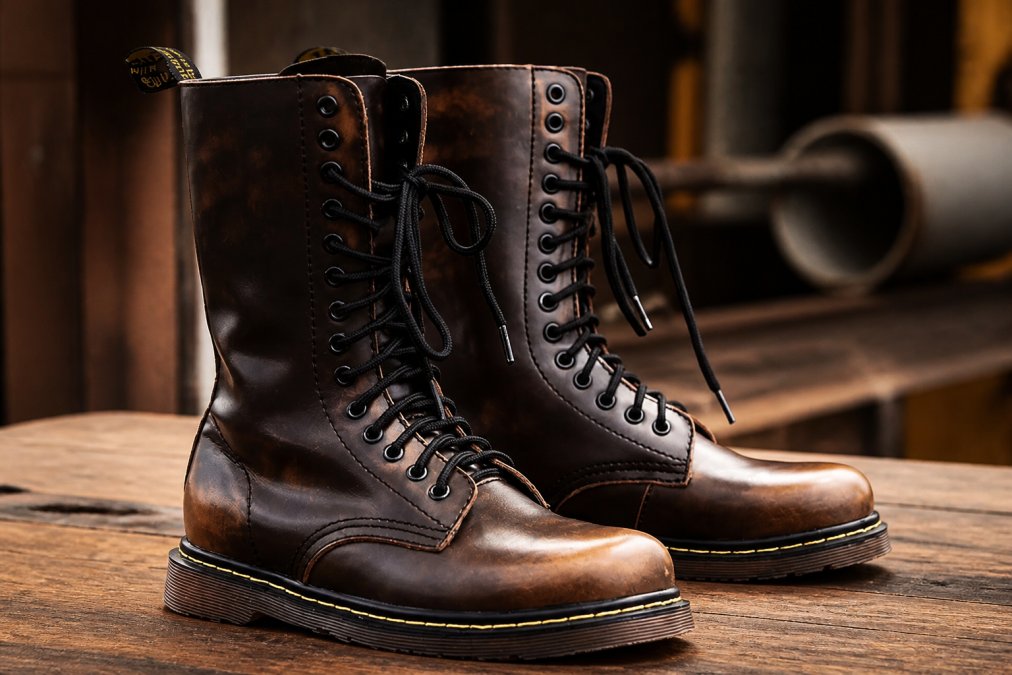
Walker Evans Full Grain Leather Boots, Best All-Rounder ($89.99)
The Walker Evans is the boot to buy if you want one pair that handles everything. Built from premium full-grain leather with strong construction throughout, this is the most versatile option in the lineup. The timeless design reads equally well with dark denim, chinos, or casual trousers.
Best for: Men who want one pair that works for work, weekends, and everything between.
Honest limitation: The full-grain leather requires conditioning every 4-6 weeks with regular wear.
Shop Walker Evans Full Grain Leather Boots at Vinthentic
Vittorio Avanzi Leather Chelsea Boots, Best for the Office ($69.99)
Office-appropriate leather boots are harder to find than they should be. The Vittorio Avanzi solves that problem with premium Italian leather construction, a clean Chelsea silhouette, and cushioned insoles that make all-day wear genuinely comfortable. The Chelsea format, with elastic side panels and no lacing, is the right choice for a professional environment. Stephen H., a verified Vinthentic customer, said: "They have a great selection of items just for my taste, and the quality is top-notch."
Best for: Finance professionals, office workers, and anyone who needs a boot that looks corporate without feeling restrictive.
Shop Vittorio Avanzi Leather Chelsea Boots at Vinthentic

Umberto Basso Cap-Toe Chelsea Leather Boots, Best Dress Boot ($69.99)
The cap-toe detail adds a visual break at the toe box that elongates the silhouette and signals formal intent. The Umberto Basso uses a high-quality leather upper, elastic side panels for ease of entry, and a durable rubber outsole with solid traction. This is the boot for men who attend formal events, client dinners, or any occasion where appearance carries weight.
Best for: Formal occasions, client-facing roles, and men who want a dress boot that doesn't sacrifice practicality.
Shop Umberto Basso Cap-Toe Chelsea Leather Boots at Vinthentic
Cedric Leblanc Combat Chelsea Boots, Most Rugged Option ($69.99)
The Cedric Leblanc combines a rugged leather upper with elastic side panels, a slip-resistant outsole for superior traction, and reinforced stitching throughout. The slip-resistant outsole is the feature that sets this apart. On wet pavement, uneven terrain, or any surface where grip matters, the Cedric Leblanc performs where a standard dress Chelsea would falter.
Best for: Men who spend time outdoors, commute on foot in varied conditions, or want a boot that won't flinch under daily punishment.
Shop Cedric Leblanc Combat Chelsea Boots at Vinthentic
Bernardo Cavallino Leather Chelsea Boots, Best Entry Price ($64.99)
The most accessible price point in the lineup, with none of the compromises you'd expect. The Bernardo Cavallino features genuine leather construction, a classic Chelsea boot design, meticulous craftsmanship, and a comfortable fit designed for all-day wear. David S., a verified Vinthentic customer, said: "I am so happy with my purchase. The shoes arrived quickly and were exactly as imagined. Perfect for daily wear."
Best for: First-time leather boot buyers, men on a tighter budget, or anyone wanting a clean everyday Chelsea.
Shop Bernardo Cavallino Leather Chelsea Boots at Vinthentic

Sizing, Fit, and Break-In Period: What to Expect
Sizing in leather boots is less forgiving than in sneakers, and getting it wrong costs you both comfort and money. The Vinthentic range runs US 6 through US 14 with corresponding UK and EU conversions.
Leather boots require a break-in period. Full-grain leather is stiff when new. The fibers need to flex and conform to your foot before the boot becomes genuinely comfortable. For most men, this takes 2-4 weeks of regular wear.
The right way to break in leather boots:
- Wear them for 1-2 hours on the first day, not all day
- Increase wear time gradually over the following week
- Apply a leather conditioner before the first wear to soften the upper
- Use thick socks during early break-in to reduce friction
If a Chelsea boot gaps significantly at the ankle or compresses the foot across the instep, that size is wrong. Leather will stretch slightly with wear, but it won't correct a fundamentally poor fit.
How to Care for Leather Boots So They Last for Years
Proper leather care is the difference between a boot that lasts two years and one that lasts twenty. The investment in quality leather boots is only realized if the maintenance follows through.
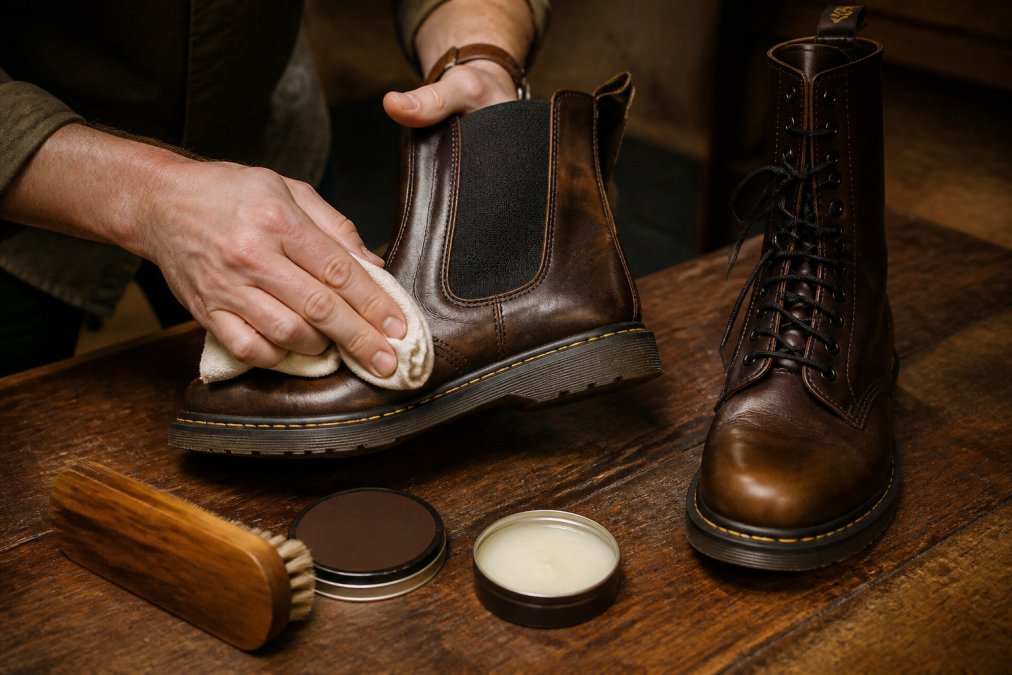
Cleaning and Conditioning
Clean leather boots before conditioning, always. Applying conditioner over dirt or salt residue traps abrasive particles against the leather surface and accelerates wear.
Basic cleaning routine:
- Remove loose dirt with a soft-bristled boot brush
- Wipe the surface with a slightly damp cloth for surface grime
- For salt stains, use a solution of equal parts water and white vinegar, applied with a cloth
- Allow the boot to dry completely at room temperature, away from direct heat
- Apply leather conditioner with a soft cloth in circular motions
- Buff lightly with a clean cloth once the conditioner is absorbed
Conditioning frequency depends on wear. Boots worn daily need conditioning every 4-6 weeks. Occasional-wear boots can go 2-3 months between treatments. Water resistance is improved significantly by a quality wax polish or dedicated waterproofing spray. Neither makes leather fully waterproof, but both reduce moisture absorption and extend the boot's life in wet conditions.
Resoling and Cobbler Access: The Long-Term Ownership Advantage
A resoleable boot, one built with welted construction, can be taken to a cobbler when the outsole wears through. A skilled cobbler can replace the outsole for a fraction of the cost of a new pair, restoring the boot to functional condition while preserving the upper, which has already been broken in and conformed to your foot.
The cost of resoling varies by cobbler and region, but the principle holds: a well-maintained welted boot that gets resoled twice has a much lower cost-per-year than a cemented boot replaced every 18 months.
Finding a reliable cobbler is worth the effort. According to The Cordwainers' guide to leather boot repair, the quality of a resole depends as much on the cobbler's technique as on the original boot construction.
What to look for in a cobbler:
- Experience with welted construction specifically
- Willingness to match the original sole profile
- Access to quality replacement rubber or leather soles
- References from previous customers
Quick Comparison: Which Boot Fits Your Lifestyle?
| Boot | Price | Best For | Key Feature | Construction |
|---|---|---|---|---|
| Walker Evans Full Grain | $89.99 | All-round versatility | Full-grain leather upper | strong, handcrafted |
| Vittorio Avanzi Chelsea | $69.99 | Office and professional wear | Cushioned insole, Italian leather | Handcrafted Chelsea |
| Umberto Basso Cap-Toe | $69.99 | Formal and dress occasions | Cap-toe detailing | Rubber outsole, elastic panels |
| Cedric Leblanc Combat | $69.99 | Rugged daily wear | Slip-resistant outsole | Reinforced stitching |
| Bernardo Cavallino Chelsea | $64.99 | Everyday value | Genuine leather, classic design | Meticulous craftsmanship |
The honest summary: the Walker Evans is the boot most men should buy if budget allows. The Vittorio Avanzi is the correct choice for office environments where cushioned insoles and Italian leather matter. The Umberto Basso and Bernardo Cavallino serve distinct formal and entry-level needs. The Cedric Leblanc stands apart as the only genuinely rugged option in the lineup.
For men asking whether these boots will look professional in a corporate setting: the Chelsea silhouette is the most office-appropriate boot format available. It reads as polished, pairs with tailored trousers without conflict, and carries none of the casual associations of a lace-up work boot. Louis T., a returning Vinthentic customer, said: "The clothes and shoes are exactly what I like. Sophisticated."
Finding quality leather boots for men that balance construction integrity, genuine materials, and real-world wearability is harder than it should be. Vinthentic's collection addresses that gap directly, with handcrafted leather footwear built for men who want boots that improve with age rather than deteriorate. From the full-grain Walker Evans to the rugged Cedric Leblanc, each pair is designed for long-term ownership, not seasonal replacement. Shop the full collection at Vinthentic and step into footwear built to last.
Frequently Asked Questions
Are full-grain leather boots actually better than top-grain?
Full-grain leather retains the entire outer surface of the hide, which means it is denser, more water resistant, and develops a richer patina over time. Top-grain leather has the surface sanded down to remove imperfections, making it more uniform in appearance but slightly less durable over the long term. For everyday wear where longevity matters, full-grain leather boots are the stronger choice. Top-grain still offers solid quality at a lower price point and works well for dress occasions.
How long should a pair of quality leather boots last?
A well-made pair of leather boots with a welted or stitch-down construction can last 10 to 20 years with proper care and occasional resoling. The key factors are leather grade, construction method, and maintenance. Boots with cemented soles typically cannot be resoled, so they have a shorter lifespan regardless of leather quality. Conditioning the leather every few months and storing boots on cedar shoe trees significantly extends their wearable life.
What is the difference between Goodyear welted and cemented construction?
Goodyear welt construction stitches the upper, welt, and insole together before attaching the outsole, creating a boot that a cobbler can resole multiple times. Cemented construction bonds the upper directly to the sole with adhesive, which is lighter and less expensive to produce but cannot be resoled once the sole wears through. For men who want boots that improve with age and offer long-term value, Goodyear welted or stitch-down construction is the better investment.
How can I tell if leather boots are genuinely well-made before buying online?
Check for these markers: the product description should specify leather grade (full-grain, top-grain, or genuine leather), and the construction method should be named. Look for reinforced stitching details, a shank for arch support, and cushioned insoles in the feature list. Genuine leather will be described with natural characteristics; synthetic blends often use vague terms like 'leather-look.' Reviewing the brand's return policy and reading verified customer feedback also helps confirm quality before committing.
How do I care for leather boots to keep them looking good?
Wipe off dirt after each wear using a soft brush or damp cloth. Apply a leather conditioner every six to eight weeks to prevent the leather from drying out and cracking. Use a matching cream or wax polish to restore color and add a protective layer. Waterproofing spray helps with water resistance during wet seasons. Store boots on cedar shoe trees to hold their shape and absorb moisture. Avoid leaving leather boots near direct heat sources, which dries out the leather quickly.
This article was written using GrandRanker
Read more

Finding the Perfect Fit: A Guide to Men's Running Shoes
Discover the perfect pair of men's running shoes for you, whether you have flat feet or wide feet. Find the right fit, support and traction for your needs.
Read more
How to Build a Capsule Wardrobe: 2026 Guide
Learn how to build a capsule wardrobe with timeless pieces, smart color palettes, and a declutter plan. Start dressing better with less. Shop NOW.
Read more