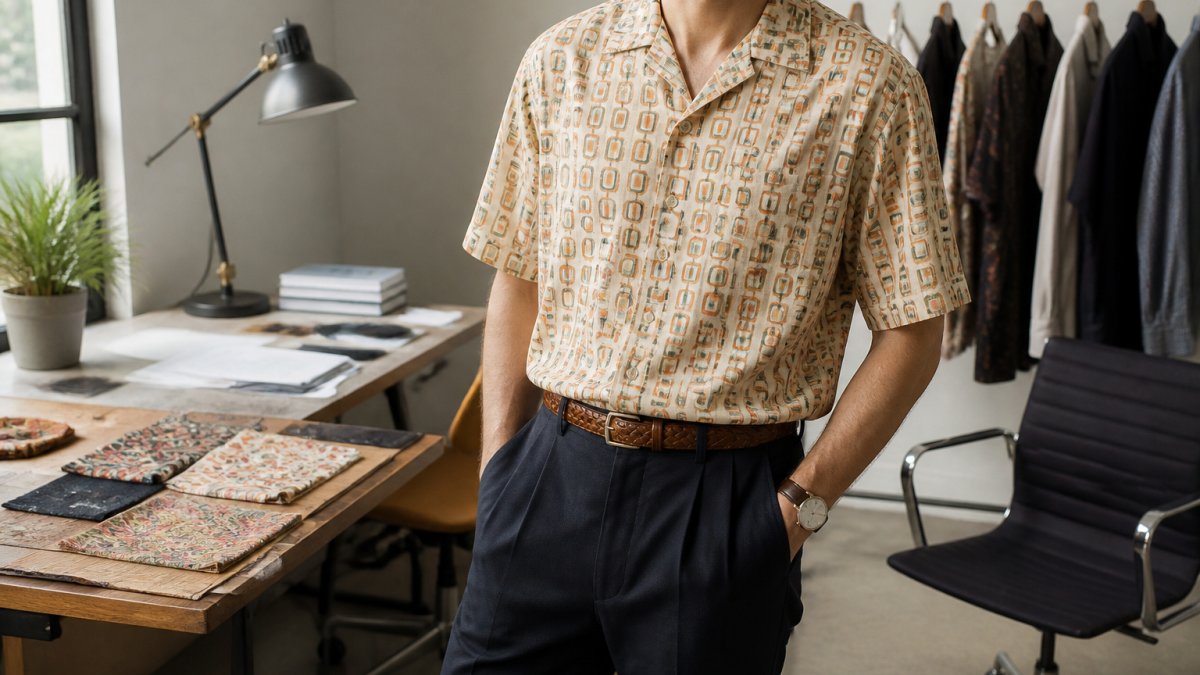
Are Retro Prints Professional Enough for Business Casual?
Last Updated: October 31, 2026
Quick Summary
Incorporating retro prints into business casual works when you match the print to your workplace formality and wear one retro piece at a time. Vertical stripes are the safest choice, while bold plaid and geometric prints suit tech, startup, and creative offices. Keep everything else solid and neutral so the print stays the focus.
- Check your company handbook and match what colleagues wear before pushing print boundaries.
- Plaid reads professional when the check is small or medium and colors are muted.
- Limit office outfits to two patterns, with the supporting pattern at least one scale smaller.
- Use the three-foot mirror check: if your eye jumps between areas, remove a patterned piece.
- Build a rotation around three or four retro anchors with neutral trousers and shoes.
Table of Contents
- What Counts as Business Casual at Your Office
- What Retro Prints Look Professional for Work
- How to Style Vintage Clothing for Work
- Business-Casual Outfits With Prints: Five Formulas
- How to Mix Prints and Patterns Without Clashing
- Fit, Fabric, and Comfort for a Full Workday
- Building a Retro Print Rotation With Vinthentic
- Frequently Asked Questions
What Counts as Business Casual at Your Office
Incorporating retro prints into business casual starts with one question: how formal is your workplace? The answer decides which patterns you can wear and which ones stay in the closet.
Men often buy a striking retro piece, love it in the mirror, then hesitate at the office door. The fix is not toning down the print.
Business casual is a dress code that sits between formal business attire and casual wear. It usually means collared shirts, tailored trousers, and optional blazers, without the requirement of a suit and tie.
Business Casual by Workplace Type
Not every office treats business casual the same way. Use this as a starting reference, then adjust to what you actually see around you.
| Workplace Type | Typical Dress Code | Retro Print Comfort Zone |
|---|---|---|
| Corporate finance or law | Conservative business casual | Subtle stripes, small argyle, muted tones |
| Tech or startup | Relaxed casual | Bold plaid, geometric prints, statement pieces |
| Creative or agency | Smart casual | Any print, mixed freely with modern basics |
| Client-facing sales | Polished business casual | One print per outfit, neutral base |
| Hybrid or remote-first | Minimal expectations | Full range, save bold prints for video calls |
If you are unsure how formal your office really is, look at what colleagues wear on a typical day and match that level. The short version: when in doubt, choose a subtle print and let the fit do the talking.
What Retro Prints Look Professional for Work
Some retro prints read as professional. Others read as a weekend costume. The difference comes down to scale, color, and how the print sits on the garment.
Here is how the most common retro prints rank for office wear:
- Vertical stripes: The safest choice. They look sharp and add structure. A Men's Slim Fit Vertical Stripe Shirt ($44.95) pairs easily with tailored trousers.
- Plaid: Professional when the check is small or medium and the colors are muted. Large, loud checks belong on weekends.
- Argyle: Refined in a knit vest or sweater. The diamond motif reads as classic menswear, not novelty.
If you are deciding which retro pieces are worth building around, start with two or three prints you love. Focus on two or three prints you love, not a closet full of experiments.

How to Style Vintage Clothing for Work
Styling vintage clothing for work is about restraint. One retro piece anchors the outfit. Everything else supports it.
Start with a neutral base: tailored trousers, a plain shirt, or dark jeans if your office allows them.
The mistake most men make is stacking retro pieces.
If you are ready to build around a single anchor piece, a versatile blazer works over almost any retro print.
Business-Casual Outfits With Prints: Five Formulas
These five outfits work because each one balances a retro print with modern basics. Copy them, then adjust the colors to your own wardrobe.

- Plaid shirt, navy trousers, brown leather shoes. The classic. Muted plaid keeps it professional.
- Vertical stripe shirt, chinos, solid blazer. The stripes add texture without shouting.
- Argyle knit vest over a white button-down, with tailored trousers. Polished and layered.
- Striped wool cardigan over a plain shirt, with dark jeans. Ideal for relaxed offices in fall and winter.
- Geometric print shirt under a solid blazer, with neutral trousers. For creative workplaces that reward personality.
For more ready-made ideas, look at the outfits above and adapt them to your own closet. Each formula works because the print does one job and the rest of the outfit stays quiet.
How to Mix Prints and Patterns Without Clashing
Mixing prints is the fastest way to look stylish and the fastest way to look messy. The difference is a repeatable method, not luck. Two patterns is a safe ceiling for an office, and three only works when one pattern is nearly invisible at conversation distance.
Vinthentic Men’s Retro Plaid Shirt →
Use this four-part formula every time:
- Assign a dominant print. This is the piece people notice first, usually the shirt or the vest. It should carry the most color and the largest scale.
- Choose a supporting pattern at least one scale step smaller. A fine stripe under a medium plaid works. A medium check under a large check does not, because the eye cannot separate them.
- Repeat exactly one color across both pieces. A navy line in the plaid should match the navy in the stripe. Shared color is the glue; without it, the outfit reads as two separate decisions.
- Keep every other element solid and neutral. Trousers, belt, shoes, and socks stay in one family, navy, charcoal, tan, or brown. This is what separates a styled outfit from a costume.
Print Pairings That Work and Pairings That Fight
| Dominant Print | Supporting Pattern | Why It Works |
|---|---|---|
| Medium plaid shirt | Fine vertical stripe tie or pocket square | Scale contrast plus a shared base color |
| Small argyle vest | Solid oxford shirt | The vest is the only pattern; the shirt provides a clean field |
| Geometric print shirt | Solid blazer and solid trousers | One pattern, two solids, the safest office formula |
| Thin stripe shirt | Small dot or micro-check scarf | Both patterns read as texture at three feet |
| Large check sport coat | Solid shirt and solid trousers | The coat is the hero; everything else recedes |
Pairings that fight: two large-scale prints, two prints with the same scale and different colors, and any print paired with a competing texture like heavy tweed plus bold plaid. If you cannot decide which piece to remove, remove the one closest to your face, the eye reads the collar area first.
The Three-Foot Check
Stand three feet from a mirror, roughly conversation distance. If your eye jumps between two or more areas instead of settling on one, the outfit is too busy for an office. Remove one patterned piece and replace it with a solid. This single check prevents most workplace print mistakes.
Start with two patterns at most. Add a third only when one of them is a micro-pattern that reads as a solid from three feet away.
Fit, Fabric, and Comfort for a Full Workday
A retro print looks professional only if the garment survives an eight-hour day. Fit, fabric, and care decide whether a printed shirt looks sharp at 9 a.m. and tired by 4 p.m. This is the practical layer most styling guides skip, and it is where retro pieces most often fail.
Fit Checkpoints That Matter Most
- Shoulder seam sits at the edge of your shoulder, not past it. A dropped shoulder on a printed shirt reads as sloppy, not relaxed.
- Chest and waist allow a flat hand to slide under the fabric. Any tighter and the print distorts when you sit.
- Sleeve length ends at the wrist bone so the cuff shows under a blazer.
Fabric Trade-Offs for a Desk Day
| Fabric | Breathability | Wrinkle Resistance | Best For |
|---|---|---|---|
| 100% cotton | High | Low to medium | Cooler offices, structured shirts |
| Cotton-synthetic blend | Medium | High | Long days, travel, hybrid schedules |
| Merino wool | High | High | Layering vests and cardigans in cool months |
| Linen | Very high | Very low | Warm offices only; creases are part of the look |
| Acrylic knit | Low | High | Budget argyle vests; runs warm indoors |
Natural fibers like cotton and merino breathe better through a long day at a desk. Blends hold their shape and resist wrinkles, which matters if you sit through back-to-back meetings. Linen looks great at 9 a.m. and rumpled by noon, fine for creative offices, risky for client-facing roles.
Comfort and Care Through the Week
- Check the care label before you buy. Machine-washable pieces stay in rotation; dry-clean-only prints sit in the closet.
- Rotate, do not repeat. Give a printed shirt a day between wears so fibers recover and wrinkles relax.
- Steam, do not iron, prints. Direct heat can flatten texture and shine synthetic blends. A handheld stepper takes two minutes and extends wear.
- Wash inside out on cold to protect print color and reduce pilling on knits.
Adapting Fit Across Body Types
The same print rules apply to every build, but the anchor changes. Broader frames carry larger-scale plaids and geometrics well because the pattern has room to read. Narrower frames do better with small-scale argyle, fine stripes, and micro-checks. If you are between sizes, size up on printed shirts and have the waist taken in, a print that pulls at the buttons draws the eye to the strain, not the pattern.
Building a Retro Print Rotation With Vinthentic
A work wardrobe works best as a rotation, not a pile of single pieces. Build around three or four retro anchors and enough neutral basics to support them.
Vinthentic designs pieces with vintage character and everyday comfort. Customers often praise the quality.
Start with a few versatile pieces:
- A retro plaid shirt for patterned days
- A vertical stripe shirt for sharper office looks
- An argyle knit vest for layering in cooler months
- A striped wool cardigan for relaxed fall and winter outfits
Each piece pairs with the same neutral trousers and shoes, so you get many outfits from a small wardrobe. That is the point of a rotation.
Frequently Asked Questions
How can you wear retro prints in a business-casual outfit?
Keep the print to one garment and build the rest of the outfit from solid neutrals. A printed button-down with tailored trousers and a plain blazer reads polished because the eye has one focal point. Choose smaller, tighter patterns over large, loud ones, and make sure the shirt fits well at the shoulders and collar. Retro prints work best when the silhouette around them is clean and modern.
Can you mix prints in a business-casual outfit?
Yes, if the two patterns share a color and differ in scale. Pair a wide stripe with a small check, or a subtle geometric print with a fine pinstripe, keeping one pattern clearly dominant. Limit mixing to two prints and anchor them with a solid trouser and solid shoes. When you mix prints and patterns at the office, restraint matters more than creativity: one bold element, one quiet one.
Are bold patterns appropriate for business casual?
Bold patterns are usually safer in creative, tech, or relaxed offices than in finance or law. If your workplace leans conservative, scale the print down or wear it on a layer you can remove, such as a cardigan or vest over a solid shirt. A good test: if the print is the first thing people notice from across the room, it may be too loud for a client-facing day.
How do you keep a retro outfit looking polished?
Press the garment, check that the print sits flat at the seams, and pair it with structured pieces: a blazer, tailored trousers, and clean leather shoes. Avoid combining a vintage print with distressed denim or worn sneakers on office days. Fit does most of the work, so have printed shirts taken in at the waist if they billow. A polished look comes from contrast between the busy print and the calm pieces around it.
Building a work wardrobe around retro prints takes a little planning, but the payoff is a closet that feels like yours. Vinthentic helps you get there with genuine leather craftsmanship, handcrafted precision, and timeless footwear and apparel built for everyday comfort. With over 20,000 happy customers, we focus on pieces that hold their style year after year. Get started with Vinthentic and build a work wardrobe that looks polished, feels comfortable, and stays timeless.

Read more
Welted vs Cemented Boot Soles: What's the Difference?
Welted vs cemented boot soles decide how long your boots last and if they can be repaired. Compare both constructions to pick the right pair.
Read more
How to Calculate Cost Per Wear for Clothes
Cost per wear is your purchase price divided by how many times you wear an item. Learn the formula, see worked examples, and use a simple calculator.
Read more