
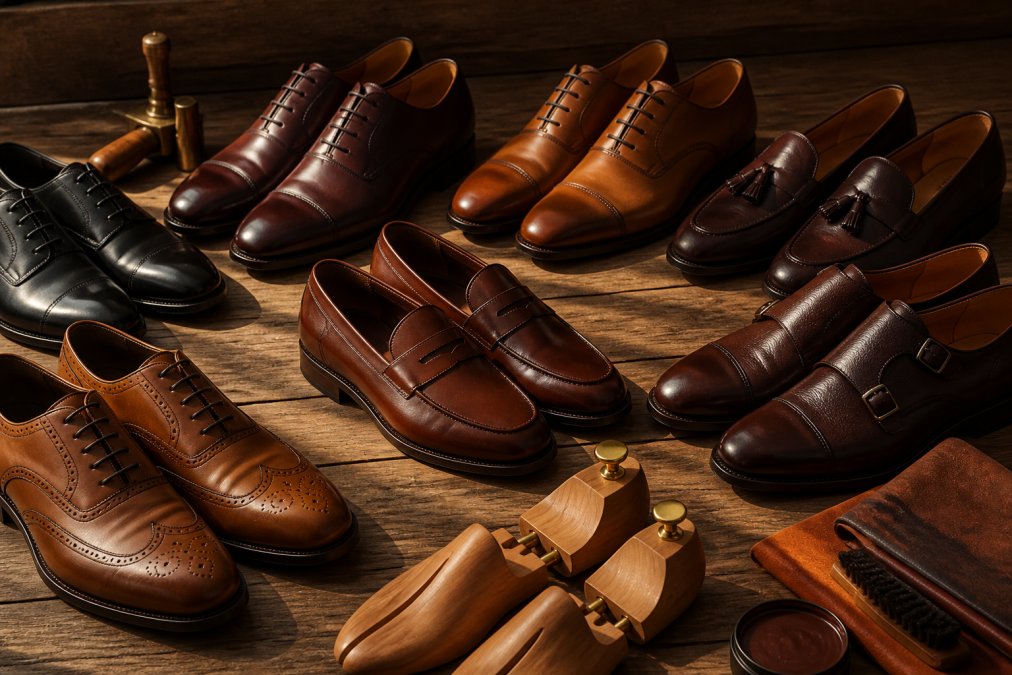
Best Leather Shoes for Professional Men: 2026 Guide
Table of Contents
- What Makes a Leather Shoe Worth Wearing to Work
- Best Leather Shoes for Professional Men: Quick Comparison
- How to Choose the Right Leather Shoe for Your Foot Shape
- Full-Grain vs Top-Grain Leather Shoes: What Actually Lasts
- How to Break In New Leather Shoes Without the Pain
- How to Care for Leather Dress Shoes: A Simple Routine
- Weather-Proofing and Resoling: Extending the Life of Your Leather Shoes
- Frequently Asked Questions
Last Updated: September 12, 2026
What Makes a Leather Shoe Worth Wearing to Work
A leather shoe earns its place in a professional wardrobe when three things line up: genuine hide, construction that holds its shape, and an insole that carries you through a ten-hour day.
That combination is harder to find than the price tag suggests. Many shoes sold as "leather" use corrected-grain or bonded uppers that crack within a season, and plenty of handsome Oxfords collapse at the heel after months of daily wear. For professional men, the best leather shoes for professional men solve one problem: sharp in a boardroom at 9 a.m., still wearable at 6 p.m.

This guide covers what separates a shoe worth resoling from one worth replacing, how to match the last to your foot shape, and the care routine that keeps leather looking new.
Best Leather Shoes for Professional Men: Quick Comparison
The strongest all-around pick for most professionals is the Men's Leather Oxford Dress Shoes at $67.95, pairing a genuine leather upper with a comfortable everyday sole.

Here is how the current lineup compares:
| Model | Price | Upper | Best For |
|---|---|---|---|
| Men's Leather Oxford Dress Shoes | $67.95 | Leather | Best overall for office wear |
| Ferano Men's Elegant Oxford Shoes | $65.99 | Antique leather | Wingtip detailing, breathable fit |
| Blaise Marinelli Classic Leather Oxford | $84.99 | Premium leather | Pointed-toe formal occasions |
| Luca Giordano Leather Oxford Shoes | $64.99 | Handcrafted leather | All-day comfort, rubber outsole |
| Sandro Botticelli Genuine Leather Oxfords | $54.99 | Genuine leather | Value pick for daily rotation |
| Vinthentic Larsini Oxford Leather Shoes | $54.99 | Premium leather | Semi-formal versatility |
| Vinthentic Imperial Oxfords | $51.99 | Premium materials | Classic design on a budget |
| William Blake Genuine Leather Oxfords | $49.99 | Genuine leather | Entry-level genuine leather |
| Vinthentic Hermes Men's Oxford Shoes | $49.99 | Leather | Timeless everyday styling |
| Vinthentic Timeless Men's Oxford Shoes | $47.99 | PU leather | Lowest-cost option |

The Ferano Elegant Oxfords stand out for visible craftsmanship: antique-leather finishing, decorative wingtips, and a rubber sole that grips better than leather on polished floors. The Blaise Marinelli is the most formal silhouette here, with a pointed toe that reads well under a slim suit. For one pair that handles interviews, client meetings, and dinner afterward, the Men's Leather Oxford Dress Shoes remain the safest call.

How to Choose the Right Leather Shoe for Your Foot Shape
Fit beats brand every time. A well-made shoe in the wrong last will hurt more than a mid-range shoe that matches your foot's volume and arch. Leather has almost no lateral give, so the last, the foot-shaped form the shoe is built on, decides whether your foot sits or fights. Start with three measurements: heel-to-toe length, width at the ball, and instep height. Most men know only the first; the other two decide whether a shoe feels snug or crushing after an hour.
Use a Brannock device, not a ruler. Any shoe repair shop or department store will measure you in under a minute, returning both your heel-to-toe and arch length. If arch length is longer, size to the arch length. Most men wear a half size too small because they only measured toe length.
Width is a letter, not a guess. Standard men's widths run from B (narrow) through D (medium), E, EE, and EEE (wide). A D-width shoe on an EE foot will not "break in", it will bulge at the sides and split at the welt within a year.
Now match the last to your foot shape:
- Wide forefoot: Look for rounded or almond toe shapes. Pointed toes pinch across the ball, where the metatarsal heads sit. A roomy toe box is the difference between a ten-hour day and a three-hour one.
- High instep: Choose lace-up Oxfords or Derbies over slip-ons. Lacing gives adjustability a loafer cannot, and a high instep will visibly strain a slip-on's vamp.
- Flat arches: Prioritize a cushioned insole and a rubber outsole. A thin leather sole offers no support, and flat-footed men overpronate, wearing the inside heel edge first. A removable insole lets you swap in an orthotic without sizing up.
- High arches: The opposite problem, you need cushioning under the ball, not the heel. A thin leather sole works here because it flexes with the arch instead of fighting it.
- Narrow feet: A pointed or tapered last holds the foot better than a boxy round toe. If the shoe slips at the heel, no insole will fix it; the last is wrong.
A common mistake is buying tight and assuming leather will stretch into comfort. It stretches a little, mostly across the vamp, and rarely where you need it. If it pinches at the ball in the store, it will still pinch in a month.
The break-in period is real, but it should feel like firm support, not friction. Anything sharper is a sizing problem. If you have a diagnosed condition, plantar fasciitis, bunions, Morton's neuroma, bring your orthotic to the fitting and try the shoe with it inserted.
Full-Grain vs Top-Grain Leather Shoes: What Actually Lasts
Full-grain leather is the outermost layer of the hide with the grain intact, and it is the most durable option because the fibers remain tightly packed. Top-grain leather has that surface layer sanded away, making it more uniform but thinner and less resistant to wear. The difference shows up in year two: full-grain develops patina and creases without splitting, while top-grain looks flawless out of the box but tends to crack along the flex point above the toes.
There is a third category: bonded or PU leather, where shredded leather fibers or synthetic material are glued together and coated. It costs the least and lasts the shortest. The Vinthentic Timeless Oxfords use PU leather, which is why they sit at the lowest price point in the lineup. Fine for occasional wear; a compromise for a daily commute.
For men building a wardrobe they intend to keep, full-grain or genuine leather uppers are the better investment. You can read more about material grading through the Leather Working Group's material standards, an industry body that audits leather supply chains for environmental and quality practices.
How to Break In New Leather Shoes Without the Pain
Breaking in leather shoes takes roughly one to two weeks of short, spaced wear. Rushing it causes blisters and permanent creasing.
The method that works:
- Wear them indoors for 20 minutes on day one, then take them off.
- Add 15 minutes per day for the first four days.
- Wear them for a half workday in week two.
- Go full days from week three onward.
Between wears, insert cedar shoe trees. They absorb moisture and hold the shoe's shape while the leather cools and sets. This single habit does more for longevity than any polish.
If a spot rubs, apply a small amount of leather conditioner there and wear a thin sock for the first few sessions. Do not soak the shoes or use heat to stretch them, both damage the finish and weaken the fibers. Also, give each pair a full day to dry between wears; skipping that recovery window is the fastest route to cracked uppers.
How to Care for Leather Dress Shoes: A Simple Routine
Caring for leather dress shoes means three things on a schedule: brushing after wear, conditioning monthly, and polishing every three to four wears. That routine takes under ten minutes a week and adds years to the shoe's life.
How to care for leather dress shoes, step by step:
- Wipe dust with a horsehair brush immediately after wearing.
- Insert shoe trees within 30 minutes of removing the shoes.
- Apply leather conditioner once a month with a soft cloth.
- Polish every three to four wears using a cream matching the shoe color.
- Let polish dry for 15 minutes, then buff with a clean brush.
- Store in a dust bag away from direct sunlight and radiators.
Conditioner replaces the oils daily wear strips out; skip it and the leather dries, then cracks along the flex lines. Polish adds a protective layer that repels water and scuffs and produces the deep shine that reads as professional.
For deeper guidance on leather care, the American Leather Chemists Association publishes technical resources on leather preservation and finishing.
Weather-Proofing and Resoling: Extending the Life of Your Leather Shoes
Most buying guides stop at the checkout. The men who get ten years out of a pair of leather shoes do two things: protect the leather from water, and resole before the upper is damaged. A shoe's lifecycle, not its sticker price, determines its real cost per wear.
Weather-proofing: what actually works
Water is leather's main enemy, and most men discover this too late. A protective spray applied every few weeks keeps rain from soaking into the grain and leaving permanent water stains. Look for a fluoropolymer or silicone-based protector labeled for smooth leather, not suede. Apply two light coats in a ventilated space and let each dry fully.
For wet-weather wear, let soaked shoes dry at room temperature, never near a heater. Stuff them with newspaper to absorb moisture and hold shape, then condition once dry. Heat dries leather unevenly, causing it to stiffen and crack, shoes dried on a radiator overnight often crack at the flex point within a month.
Snow and salt are a separate problem. Road salt is alkaline and will eat through leather and stitching if left on. Wipe shoes with a damp cloth the same day, then condition. Do not use vinegar, it strips the finish; a dedicated salt-removal leather cleaner is safer. Rubber overshoes or galoshes are the cheapest insurance for a commute, costing less than a single resole and keeping both the leather and the welt dry. For men who walk to transit or park blocks from the office, they are not optional in winter.
Resoling: the test of whether a shoe was worth buying
Resoling is where quality construction pays off. Shoes with a stitched welt, Goodyear welted, Blake stitched, or storm welted, can be resoled by a cobbler, often multiple times, for a fraction of a new pair. Bonded or cemented soles cannot; when they wear through, the shoe is finished. This is the clearest dividing line between a shoe you keep and one you replace. A cobbler can typically resole a stitched shoe two to four times over its life, resetting the outsole and often the heel, reconditioning the welt, and replacing worn cork filler. The upper is what you preserve, the sole is a wear part. Investing in this level of craftsmanship ensures that your footwear remains a cornerstone of your quality wardrobe basics for years to come.
Signs it is time for a cobbler:
- The outsole is worn thin at the heel or ball.
- You can feel the ground through the sole.
- The welt stitching is fraying.
- The heel has worn unevenly on one side.
- Water seeps in through the sole within minutes of walking in rain.
Do not wait until the sole is through. Once the outsole wears into the midsole or welt, the repair becomes a rebuild and the cost climbs. A resole at the first sign of thinness is cheaper than one done after a hole forms.
A rubber outsole, like the one on the Luca Giordano Oxfords, handles wet pavement and long commutes better than a leather sole and needs less frequent replacement, the practical choice for men who walk to work or take public transit. Leather soles look sharper and breathe better, but wear faster on concrete and are slippery on wet tile.
The cost-per-wear math
A $50 pair replaced every 18 months costs more over five years than a $150 pair resoled once. The math is about how many times the shoe can be renewed. When you evaluate a pair, ask two questions: is the sole stitched, and can the upper survive a resole? If either answer is no, you are buying a disposable shoe at a non-disposable price.
On the sustainability side, resoling and conditioning are the two habits that keep leather footwear out of landfills. The U.S. Environmental Protection Agency's materials management guidance outlines how extending product lifespan reduces waste, and footwear is one of the categories where repair delivers a clear benefit.
Frequently Asked Questions
What are the most comfortable leather dress shoes for all-day wear?
Look for shoes with a cushioned insole and a flexible rubber outsole. Oxfords with a padded footbed, like the Luca Giordano Leather Oxford Shoes, reduce fatigue during long workdays. A proper fit also matters: your heel should not slip, and the widest part of your foot should align with the shoe's widest point. Avoid styles with hard leather soles unless you add an insert.
How can you tell if leather shoes are high quality?
Check the leather grade and construction. Full-grain leather shows natural pores and develops a patina over time, while corrected-grain looks uniform but less durable. Look for welt construction or stitched soles rather than glued ones. The leather should feel supple, not plastic-like. A good test: press your thumb into the leather; fine creases indicate quality, while sharp wrinkles suggest lower-grade material.
What is the difference between full-grain and top-grain leather for shoes?
Full-grain leather uses the entire hide's top layer, preserving natural markings and fibers. It is the most durable and breathable option, developing a rich patina. Top-grain leather has the top layer sanded and buffed to remove imperfections, making it more uniform but less breathable and slightly less durable. For professional men, full-grain is worth the investment for longevity, while top-grain offers a polished look at a lower price.
Which leather shoe styles are appropriate for business professional attire?
Oxfords are the most formal, especially cap-toe or plain-toe styles, and pair well with suits. Derbies are slightly less formal but still acceptable in most offices. Loafers work for business casual but may be too casual for strict formal environments. For a versatile professional wardrobe, a dark brown or black Oxford is the safest choice. The Men's Leather Oxford Dress Shoes from Vinthentic fit this need perfectly.
How do you properly maintain leather dress shoes to ensure longevity?
Clean with a horsehair brush after each wear, condition every 4-6 weeks, and polish as needed. Use cedar shoe trees to absorb moisture and maintain shape. Rotate your shoes to let them dry fully between wears. For weather protection, apply a waterproofing spray. Store in a dust bag away from direct sunlight. Following this routine, a quality pair can last 5-10 years with resoling.
Read more

Men's Professional Style Guide 2026: Modern Office Wear
Elevate your work wardrobe with our men's professional style guide 2026. Discover timeless staples, modern trends, and expert tips to dress sharp every.
Read more
Durable Vintage Inspired Clothing Review: 2026 Guide
Durable vintage inspired clothing review covering fabric quality, fit, pricing, and longevity. Learn how to spot quality pieces and build a lasting.
Read more